Showing posts with label misadventures. Show all posts

Thursday, July 5, 2012

The Day the Kawarau River Punched Me in the Face

Kawarau Bridge, the birthplace of commercial bungy.

In Queenstown, NZ, the question of greeting in hostel common rooms isn't the usual "So, how long are you staying?" or "Where are you from?" Instead, without fail, it's "What are you doing tomorrow?"

I loved Queenstown from the moment I drove into it, more in spite of its adrenaline-junky status than because of it. It comes closer to picture-perfect than any other town I've seen, and its gorgeous setting certainly doesn't hurt, with stunning views and a staggering range of outdoor adventures on offer.

Queenstown was the last stop on the solo portion of my road trip around New Zealand and I'd already done most of my thrill-seeking for the trip; the only thing left was bungy-jumping. If I had a bucket list, bungy would not be on it - as I've said before, I am not an adrenaline junky. But Queenstown is the birthplace of commercial bungy and if I was ever going to hurl myself off a ledge with no more support than a glorified rubber band, I figured there was probably no better place for it than where it all began. In the interest both of budgeting and not giving myself a chance to back out, I booked my non-refundable jump date online well before I arrived in New Zealand.

Still laughing - I hadn't actually looked down yet.
Photo credit: AJ Hackett Bungy
I had chosen to jump from Kawarau Bridge, the original commercial jump site, operated by AJ Hackett Bungy. At 43 meters (~141 feet), Kawarau is the shortest of AJ Hackett's drops on offer in Queenstown, and I was feeling pretty cavalier about the whole thing as I boarded the bus for the 20-minute drive to the jump site. (After all, I'd jumped out of a plane barely three days earlier. Clearly, this would be a piece of cake.)

Upon arrival, I tightened my sandals and pulled off my watch and earrings, laughing at the "I Was Too Chicken" shirts on display in the gift shop. In a brilliant flash of self-preservation, I decided I didn't want to wait around watching people jump first, I just wanted to do it. I was second in line out on the bridge, joking with the British guy behind me while I climbed down onto the back part of the ledge to have my legs wrapped and secured.

I told the guys operating the jump that I wanted to touch the water (the options are bungy over it, touch it, or get dunked), and waddled forward when they told me to. Distracted by the guy telling me to look at various cameras, I didn't actually look down until they were resetting one that hadn't gone off the first time. All of a sudden, my heart leapt into my throat. I was supposed to voluntarily hurl myself into all that thin air, when every instinct was screaming to back up - very quickly - onto safer ground? I gulped.

Not a bad jump, actually. I was terrified I wasn't
going to get far enough from the platform.
Photo credit: AJ Hackett Bungy
The reset camera flashed, and the operator, thoroughly unimpressed by the feat of sheer insanity he was about to witness, began to count down from five. Much, much faster than I thought he should be counting. Jittery thoughts rushed through my brain. How am I supposed to do this? Who in their right mind is actually capable of jumping off a ledge? This is freaking terrifying. As he reached "three," one thing became clear: If I don't go when he says "one," I'm never going to get off of this thing.

I took a deep breath, braced myself and, as he finished the countdown ("...one. Bungy!"), threw myself forward, arms outstretched.

There was a split second of weightlessness, of absolute freedom, and then I abruptly realized that my stomach was still on the ledge, while the rest of me was hurtling downward, much too quickly.

The water of the Kawarau River, rushing up at me, was a gorgeous color and I stretched my hands toward it, not wanting to miss my shot to dip my fingers in. Except, I realized, my brain still moving at warp speed, that a whole lot more than my hands was about to get wet. I quickly clamped my mouth, open from shrieking on the way down, tightly shut, but didn't manage to get my eyes closed before I was submerged in that gorgeous blue, the color forever imprinted on my brain as it swirled around me.

I surfaced almost before I'd had a chance to register the freezing temperature of the water and bounced around like a yo-yo (somehow also managing to spin myself around in dizzying circles) until the retrieval raft got close enough to reel me in. I lay on the bottom as they untangled me and floated us to the stairs, laughing as I stared back up at the bridge.
Soaking wet, but safely down.
Photo credit: AJ Hackett Bung

I waited partway up the stairs to watch Ryan, the British guy who'd been on the same bus and behind me in line on the bridge, jump. Still shaking, we laughed our way back up to the viewing platform, comparing notes. He'd asked to get dunked and, somehow, was only wet to mid-torso, while I was soaked to mid-thigh. Someone must have misheard or miscalculated something somewhere! But it had been an adventure, and I had done it. (Although what that said about my sanity, I wasn't quite sure.)

Safely back on my own two feet! (With crazy hair, courtesy of my
impromptu dunking.)
Safely back on the viewing platform, I watched some of the other jumpers and was very glad I hadn't taken the time to do so before jumping myself - it was positively terrifying to watch. Waiting for the bus back into town, we all swapped photos and brandished our "Bungy Jumper" t-shirts. My head was starting to ache, but I put it down to the cold water and too much post-jump shivering, which was more in reaction to the jump than the temperature of the water.

Back at the hostel, I told my "accidental dunking" story and called my parents to let them know I'd survived my last crazy stunt of the trip, before making my way back to my room. I'd braced my pack at the foot of my bunk, against a full-length mirror; glancing into it as I pulled out dry clothes, I gasped. No wonder I had a headache, the skin underneath my left eye was swollen and the lid was starting to bruise! Since I hadn't asked to be dunked, I hadn't tucked my chin the way you're supposed to and my face had slapped the water as I went in, giving me my first-ever black eye.

Despite the black eye (which I walked around feeling self-conscious about for the following week), I'm glad I took the plunge, so to speak. Bungy-jumping was a once-in-a-lifetime experience that I have no desire to repeat but definitely wouldn't have wanted to miss. And it's certainly the most extreme - and unique - travel misadventure I've ever had. After all, how many people do you know who've been punched in the face by a river?

The hand-over-the-mouth, what-was-I-thinking?! moment when I first look down is priceless. (Also evidence that I had completely forgotten I'd bought a photo/video package with my booking. Oops.)
Video credit: AJ Hackett Bungy

Friday, February 11, 2011

The Hiker With the Black Umbrella

The crazy Tasmanian weather means you can go from this
beautiful sunshine over Freycinet National Park's lovely
Wineglass Bay to cranky thunderstorms in an hour or less.
You have got to be kidding me, I thought, looking up as the first raindrops hit the rocks around me. What had happened to the bright, sunny afternoon I'd been enjoying? I was in the second half of an 11km (not quite seven-mile) hike in Tasmania's Freycinet National Park with a friend and, with scrubby trees and wiry bushes leaving just enough trail to walk on, there was absolutely nowhere to go. I heaved a sigh and reached for my pack.

Before you start wondering just how much of a wuss I'd have to be in order to be that put out by a few drops of rain, let me tell you a little about family vacations when I was a kid: they usually involved a couple of weeks in national parks in the U.S. or western Canada and the one question my dad could always be counted on to ask before we left home and as we set out from our campsite each day was, "Do you have your parka?" (In Pinneo family lingo, "parka" means "waterproof jacket," not "big, heavy, snow-proof coat.") With much eye-rolling and face-making, I would say yes, grumpy that I had to lug such an unwieldy thing around all day, with little likelihood of actually needing to wear it. Parkas are ugly, I would complain. It's too big, I look stupid. Whenever I could possibly get away with leaving the thing behind, I did.

Clouds starting to gather near Wineglass Bay.
So it was a bit ironic that, prior to leaving for Australia, a waterproof jacket was on my to-buy list, since one of my first stops would be Tasmania, capital of unpredictable weather conditions. I found a few I liked online, but wanted to make my purchase in-store, since I wasn't sure of the sizing. No worries, I thought; since I would be spending a few days in Los Angeles before heading across the Pacific, I could just pop into an REI store and find what I wanted. Unfortunately, it turns out that REI stores in Southern California don't really carry Outdoor Research (OR) products, which was what I'd been looking at. There was a similar jacket by The North Face that could have worked, but it was a little heavier than I wanted for the Australian summer weather, and REI's own similar line was more expensive than OR's. So I decided I'd wait to buy a jacket until I got to Australia, either in Tasmania or once I was settled in Sydney. In the meantime, I'd just have to tough it out with an umbrella and hope for clear skies.

I had not, however, planned on ending up on a narrow Tasmanian hiking trail, in pouring rain, with nothing waterproof at hand except a black, travel-sized umbrella. If it had been just me and the usual hiking paraphernalia in my daypack, I would have kept on going and ignored the rain, no problem. I had a hat to keep water out of my eyes and it wasn't cold, by any means. But I had my Kindle and my iPod in my pack and no other way to protect them from the downpour, so, rolling my eyes at my own idiocy, I popped open the umbrella, hitched it over my shoulder so that it covered as much of my pack as possible and set off at as fast a clip as I could manage, eyes focused enviously on the water rolling off the hood of my friend's jacket.
The sky over an isthmus on the Freycinet Peninsula,
looking a little more foreboding just before the rain started.

The image of myself in my mind's eye as I hiked made me want to both laugh and bang my head against a wall. Hiking with an umbrella, I thought. Could I be any more ridiculous? The umbrella, wider than my shoulders and much less easy to maneuver, snagged on bushes and branches every few steps and I gritted my teeth as I continually yanked it free, trying to climb without bending over and exposing the bottom of my pack to the rain. The few hikers who passed us gave me puzzled looks and I smiled sheepishly, wishing I could disappear into the ground and take my absurdly out-of-place umbrella with me.

An hour or so later, my friend and I made it back to the carpark and scrambled into our tour's minibus to laughing applause. Soaked to the skin - this hadn't been any gentle shower but a steady downpour, complete with rolling thunder - we collapsed in our seats and I gratefully put away my umbrella, sure of three things: 1) I never wanted to hike with an umbrella again; 2) I was buying a waterproof jacket the minute I found a sporting goods store back in Sydney; 3) My dad was never going to let me live this down.

And there you have it: the day I became "the hiker with the black umbrella."

Saturday, January 22, 2011

Snapshots: Inis Mór

Standing on the deck of the ferry, I inhaled deeply, grinning at the smell of the sea air and the feel of the sun on my face. This was not the weather I had expected to find in the West of Ireland in April, but I wasn't about to complain. Nor was I at all tempted to go inside, despite the crisp sea breeze. I'd propped myself against the outside wall of the ferry's main cabin, where I was partially shielded from the wind, and leaned back to watch the largest of Ireland's Aran Islands approach on the horizon: Inis Mór.

The coast of Inis Mór, dotted with famine walls.
As we docked, I debated my transportation options for the day: minivan tour, bike rental or hoofing it. Having taken a bus tour of The Burren, the Cliffs of Moher and Aillwee Cave the day before, I wasn't about to sign on to be cooped up in another car for hours, and renting a bike felt like an unnecessary expense on such a gorgeous spring day, so I opted to walk.

Walking along Inis Mór's main road, outside Kilronan.
The spring sunshine had apparently addled my over-planner's brain, since I didn't actually know how far it was from the dock to Dún Aonghasa, the medieval cliff fort that I'd decided would be my target destination. This was completely out of character, but I was enjoying wandering around, drinking in the scenery, too much to care. (It also didn't dawn on me to question why I hadn't seen anyone else on foot until I'd been walking for about an hour.)

I wandered past ruins...


...past thatched-roof houses...


...past some of the hundreds of miles of famine walls on the island, built during the Great Famine of the 1840s for about half a penny per worker per day...


...past beaches and numerous cows....


Eventually, I started to wonder if I should have paid a little more attention to the length of the island that was probably noted somewhere in my guidebook - or asked someone how far Dún Aonghasa was from Kilronan. Since I'd spent about an hour and a half eating lunch and then shopping for an Aran sweater, mid-afternoon was rapidly approaching and I was starting to get a little worried about making it back to the dock for the 5pm ferry - the only one before the next day.

Finally, I could see what had to be the cliff fort up ahead (although it took me a while to realize that it was too tall to be another famine wall, and that the daylight coming through a section of it was probably a door):


I picked up the pace and stopped taking photos every five feet, intent on making it to Dún Aonghasa with enough time to explore a bit before I had to hurry back to the dock. I made it to the visitor center, paid my student entry fee (a very reasonable €1; €3 for non-student adults) and started up the trail to the fort at as fast a clip as I could manage.

The winding trail between the visitor center and the fort from near the top.
As I entered the outer enclosure of the fort itself, I looked around at the rock walls and well-trodden grass, trying to picture how it would have looked as a community. It was interesting, knowing that humans had been living in this area for more than 2,500 years, but it wasn't the impressive stronghold I'd been expecting.

Looking at the space inside the middle enclosure of the fort, from near the entrance to the inner enclosure.
Then I stepped into the center of Dún Aonghasa and immediately changed my mind. The sound of the sea, subdued in the larger, more open outer and middle areas of the fort, echoed off the rocks and sent wind whipping through the half-circle of the fort's inner enclosure. I stepped to the edge and had trouble catching my breath as I sat down to marvel at the view: between the power of the ocean crashing at the base of the island below, the unscalable cliff face rushing vertically to meet it and the beauty of the sun glancing off the water as far as I could see, I was dazzled.

Looking southeast along the coast. This side of Inis Mór is ceaselessly battered by the Atlantic Ocean; Kilronan and most of the settlements cluster around and spread out from the more sheltered bay at the island's northeast corner.
Looking the other direction along Inis Mór's southern coast.
I wanted to stay, soaking up the beauty and strength of the cliff fort for hours longer, but I was already going to have to run to catch the ferry, so I reluctantly made my way back down the trail, pausing just long enough to grin at the cows lying placidly in a small pasture near the visitor center.


I headed back down the road and tried not to panic when I saw that even the minivan tours were starting to head toward the dock. I didn't have anything with me except a bottle of water, my camera, a guidebook and the sweater I'd purchased after lunch, and I really didn't want to search out a hostel room when I had a cozy one, with things like my toothbrush and clean clothes in it, that I'd already paid for back in Galway.

I passed a small café just as a tour was coming out of it to get back in their minivan and seized the opportunity. I waved at the driver and dashed across the road. I explained my predicament and asked if he had any room - at that point, I was happy to pay for a seat in any vehicle faster than my legs going in the right direction - or if he knew of any taxi or bus service on the island. His tour had one seat open, so he told me to go ahead and hop in. I thanked him profusely and did so, asking how much the tour was. He was kind enough to only charge me €5, although I'm sure the full price was at least twice that.

Thanks to the driver's willingness to pick up idiot tourists who hadn't quite paid enough attention to planning their day, I made it to the dock with time to spare and was able to sit and watch the ferry come in.


Inis Mór is a place I'd like to get back to and spend more time exploring. There are footpaths and bike-able roads all over the island, which it turns out I only covered about half of that afternoon (~7km, or ~4.3mi, as opposed to the 14km+ of the island's full length). I'd also like to go back to Dún Aonghasa when I don't have to leave in a rush. And although this lapse in over-planning and exercise in winging it was probably good for me, and I certainly enjoyed the day, I've been careful to calculate times and distances in similar situations since!


Friday, November 19, 2010

The Mexican Mishap Hat Trick

By Tanenhaus, Creative Commons
You know the saying that bad things come in threes? Well, apparently travel experiences aren't exempt. I've been pretty lucky in my wanderings to date and I sincerely hope my general pattern of positive travel experiences continues, but my first trip south of the border was an exception.

I was 12, and my parents wanted to take me somewhere I could learn to snorkel during my elementary school's spring break. They'd been to various parts of Mexico with my brother years before and had enjoyed it, so they thought, "Why not Baja?" And, not being the parents of a college student at the time, they decided San José del Cabo, next to Cabo San Lucas, was the perfect spot. I was thrilled. I'd been to Canada, but we'd always driven, so this would be my first international flight.

We took something like Super Shuttle from Los Cabos International Airport to our hotel the morning we arrived. My parents exchanged an uneasy look as the shuttle picked up three college students, probably 18 or 19 years old, each with a beer already in hand, who were also staying in San José del Cabo. I was trying desperately to look older than 12 and more worldly than I was, but I still felt my mom's what-have-we-gotten-ourselves-into alarm start to go off in the seat next to mine.

The next day or two passed fairly uneventfully. We drove around the area in our beat-up VW bug rental car, which I loved for its sunroof (without a pane of glass, so it couldn't be closed) and the fact that the backseat didn't have seat belts, so I was free to stretch out across it and read or watch the scenery fly by. My first snorkeling lesson passed without incident. My parents were still uneasy about the fact that they had clearly picked a spring break party destination for college kids, but San José del Cabo was quieter than Cabo San Lucas, so we didn't lose any sleep. I was disappointed that the men in the market wanted my American money more than the pesos I was so eager to spend, but I found a pretty silver and mother-of-pearl bracelet, so I was mostly appeased.

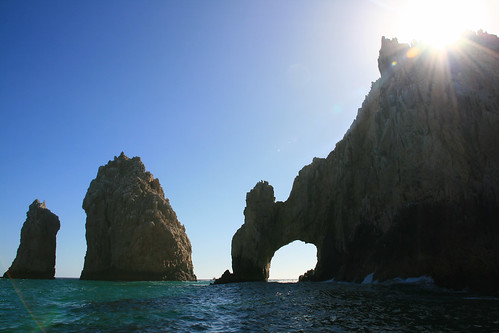
We decided to go out to El Arco de Cabo San Lucas (Lands End), which my dad wanted to see, so we joined a group of fellow tourists on a water taxi and sped across the bay. When the taxi driver ran the boat halfway aground and started yelling "Jump! Jump!" as we arrived at Lands End, I had to stifle a laugh. People "disembarked" over the sides until the waves started carrying us back out to sea, at which point the driver yelled "Stop! Stop!" until he could run the boat aground again and repeat the process.

My parents and I took our turn the second time the driver ran the boat aground. My parents went off one side, one after the other, and I chose to jump off the less crowded bow of the boat. As I landed, I heard my mom cry out and turned to go to her, but my leg was stuck. The bow rope had been hanging loosely from the underside of the bow and I had put my leg straight through one of the loops as I jumped. Struggling to hold the rope still enough in the waves to get my leg out of it, I saw my dad reach my mom and take her pack as he started to help her out of the water - she had twisted her ankle as she landed - neither of them aware that I wasn't already up on the beach.

Still stuck in the rope, I felt myself being dragged further into the water as the boat started to drift away from the beach again. The bow was too high for anyone in the boat to see me, and the steep angle of the rope from the bow to the water was making it difficult to pull my leg free. One of the other passengers, half of a couple on vacation, saw me and ran over to help, shouting at the driver. The driver didn't hear him over the water (but my parents did, and headed toward us), but someone else to hold the rope steady while I pulled my leg out of the loop was all I needed and I was free before the boat drifted much further.

After thanking our fellow passenger, my parents and I made our way up onto the beach, my mom and I hobbling, and sat down on some boulders away from the water's edge. The wind had picked up and was blowing sand into the rope burn on the back of my knee as I tried to inspect it. I heard a shout and looked up just in time to see someone's beach umbrella, freed by the wind, flying toward us. It looked like it would go over our heads, but it hit a pocket of air, bounced and smacked my dad in the face instead. We sat there, staring at each other. In the space of ten minutes, we'd gone from perfectly healthy to having a sprained ankle, a nasty rope burn and a bleeding fat lip, one unpleasant injury for each of us.

There are other places in Mexico I'd like to visit, but I don't think I'll be going back to Cabo anytime in the next 60 years. I'd really rather not give Baja a chance to repeat its hat trick of injuries; I still have the scar from the last one.