Showing posts with label Italy. Show all posts

Thursday, January 13, 2011

Americans in Florence: Obnoxious vs. Incognito

No logos or flags here!
Like many travelers, I do my best to blend in on the road. I don't actively hide the fact that I'm American and if anyone asks where I'm from, I'll tell them (although I'll probably make them guess first), but neither do I advertise my nationality. I don't wear shorts or hoodies in Europe, I don't wear American flags or baseball caps emblazoned with the logo of a U.S. sports team, political organization or school and I certainly don't wave my passport around. I speak as much of the local language or dialect as I can and try to learn the customs out of respect for the people who live by them, not to mention in hopes of leaving a positive impression behind for the foreign visitors, including my fellow Americans, who arrive after me. So when I see Americans doing exactly the opposite, flaunting their nationality, completely ignoring local customs and speaking - loudly - in American-accented English, it never fails to make me grit my teeth in frustration.

I ran into one such group of Americans in the middle of fall break during my year abroad. Four of us had traveled together to Florence for several days and we were splitting up - two of us heading to London and the other two further south in Italy - the next morning. We'd had a wonderful time in Florence and wanted to celebrate our last night en vacances together with a nice dinner, so we found a place in the heart of the city and sat down, rubbing our hands together in greedy anticipation of more delicious Italian cuisine.

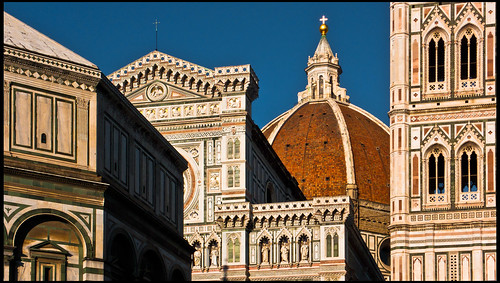
I went to Florence to see things like Il Duomo, not to hear
tourists arguing with each other at the top of their lungs.
Since the four of us were all enrolled in the same study abroad program, one that required its students to speak French 100% of the time, we had decided at the beginning of our trip not to fall out of practice on vacation. ("Practice" aside, we'd learned during recent parental visits that our various regional accents in English made it nearly impossible for any of us to complete a sentence without at least one of the other three bursting into a fit of laughter. With friendships formed in French, we just sounded too strange to one another in English to make it practical.) I felt far less visible as a French tourist than I ever had as an American, and I was enjoying it.

The table of girls seated behind us at the restaurant, however, clearly had no such reservations. They chattered away in English, much more loudly than was necessary, and my friends and I rolled our eyes at each other and wondered why Americans so often seemed unaware of the volume of their voices in comparison to the people around them. Did we do that when we spoke English, we wondered? What was it in American DNA that demanded our conversations be loud enough for everyone around us to hear?

Street art, Firenze-style! (And no one can knock this one
against the wall...)
As we talked, the painting that hung over our table began to rock against the wall at random intervals. We looked up in confusion and realized that it stretched the length of the wall our table was against, meaning it also hung above the table of the girls behind us. One of them had the back of her shoulder leaned against the bottom edge of the frame and every time she moved, so did the entire ten-foot-long painting, to which she and her friends were apparently oblivious. We tsked under our breath and went on with our conversation, but finally one of my friends seated against the wall couldn't take the constant nudging of the painting anymore. After a quick consultation, during which we decided the girl seemed the type to tell another American student to mind her own business, my friend turned around and said, in a heavily French-accented voice, "Excuse me, ze painting? It moves."

The girl gave her such a disgusted look that I nearly burst out laughing, but my friend returned her glare levelly and the girl finally shifted her shoulder away from the wall, then turned and started muttering - not quietly - with her friends about what a pain the French people behind them were. We snickered under our breath and dug into our dinner.

Just for the humor quotient, those few moments in Florence remain one of my favorite memories of that trip, but the memory of the dichotomy between two tables of American girls keeps me mindful of my actions and my attitude whenever I'm traveling. Whether I'm speaking another language and not obviously American to anyone but customs agents or revealing my nationality with the pronunciation of every word out of my mouth, I'm conscious of doing whatever I can to blend in and respect the local culture.

Certainly not all, or even most, Americans are as oblivious to their surroundings or as rude to the people around them as those girls were, but the reputation Americans have as obnoxious tourists in much of the world is due to those like them. The poor attitudes and lack of respect of that minority have painted the rest of us with the same brush and overcoming the negative impressions they've left behind can be challenging. That's why, whenever anyone asks my advice about traveling, manners, following local customs and paying attention to your surroundings are at the top of my list. As an "obnoxious American," I'd never get anything like a real look at what life is like around the world - and that's too much a part of the reason I travel to miss.

Wednesday, November 3, 2010

Profiles in Transit: Antonio

Creative Commons, guillenperez
The walls of the buildings around the piazza diffused the afternoon sunlight so that it flowed over the cobblestones, gilding them with that spectrum of light that is so uniquely Tuscan. The sun's rays spilled over my skirt, drawing me into the picture-perfect Florentine afternoon as though I belonged there.

I smiled to myself as I wrote my postcards, pausing often to look around the piazza and bask in the October sunshine, happy just to sit and enjoy the afternoon while my friends explored a museum I hadn't had energy left to gear myself up for after spending hours at the Cattedrale di Santa Maria del Fiore and the Galleria dell'Accademia.

An elderly gentleman walked into the square and took the seat adjacent to mine on the circular bench where I was writing. After several moments, he spoke and, since I was the only one around, I looked up and said "Scusa?" He repeated himself, gesturing toward me, then tapping his left arm. I caught the word sinistra and assumed he was commenting on the fact that I was left-handed, so I nodded. My limited Italian didn't offer any clues about his next statement, so I shook my head and said, "Non parlo italiano, signore, scusami." He grimaced, nodded and went back to watching the few people wandering through the piazza. Two or three minutes later, I saw the man turn back toward me out of the corner of my eye and heard, "Parlez-vous français, mademoiselle ?" I turned toward him, grinning, and said, "Oui !"

We spoke about trips he'd taken to France, how I was enjoying my second visit to Florence and how much I had loved San Gimignano on a trip a few years before. When I mentioned that I was actually American, not French, he told me he thought it was wonderful that I was taking advantage of my youth by traveling. It's impossible not to learn something new about life when we travel, he told me, and learning about life is how we come to know ourselves and the people around us. As he got up to leave, he took my hand in a warm, strong grasp that reminded me of my grandfather's and asked my name. "Enchanté, Jessalyn," he said, "Je m'appelle Antonio."

I spoke with Antonio for no more than ten minutes on that afternoon in Florence, and our paths haven't crossed since. I don't know what made him think to ask if I spoke French - if he saw the postcard to my French host mother, or if it was just a hunch. But the truth of what he said has stayed with me and, whenever I think of Florence, the first thing that comes to mind is a man named Antonio and the advice he gave me on a sunny October afternoon.

Tuesday, October 12, 2010

Profiles in Transit: Teaching Italian by Impatience

Courtesy of McLoy2008, Creative Commons
Italy, the second stop my parents and I made during my first trip out of North America at 15, was my first experience spending time in a country where my only knowledge of the language was whatever I could find in the phrasebook. I refuse to ever start a conversation by addressing someone in a language other than their own, no matter how pathetically, so I had learned the basics: Buon giorno ("Hello"), Parla inglese o francese, per favore? ("Do you speak English or French?"), Vorrei... ("I'd like..." - when in Italy, being able to order the amazing food is critical.) and some other basics, like counting to ten, please, thank you and the omnipresent scusi, for getting through crowds at least semi-politely (which, I realize, is completely un-Italian).

Throughout Florence and San Gimignano, my limited Italian worked beautifully. Someone always knew enough English or French to talk to me after I gave them my standard greeting, and my food vocabulary increased by leaps and bounds, supplemented with great words like cinghiale - wild boar. Fun to say, although my dad enjoyed the actual eating of it much more than I did.

On the train to Sorrento by way of Naples, however, I hit a linguistic wall in the form of a Trenitalia employee. I had wandered into the dining car in search of some water and approached the bored-looking woman behind the counter with a smile.

"Buon giorno!"
She nodded in return.
"Parla inglese, per favore?"
She gave a brief shake of her head and half arched a brow at me, as if to say "Why would I? And now what are you going to do, ragazza?"
"Parla francese...?"
Another head shake. Hm. Well, I'd seen enough ads for bottled water, maybe I could do this.
"Vorrei...una...um...una bottiglia di acqua? Per favore? Naturale, per favore? ("Can I have a...um...a bottle of water? Please? Still, please?")

The woman gave me a look that said, "If it didn't take so much effort, I would roll my eyes at you. Why did you ask me to speak two other languages?" and rang up the water before muttering the total at me. I paid, said "Grazie!" and sped back to my seat to tell my parents I'd spoken a whole non-pasta-related sentence in Italian.

That Trenitalia employee, sullen though she may have been, taught me a lesson that's come in handy many times over the years: it's when under pressure to communicate that you realize the full extent of what you know. That's the premise of language education by immersion: you subconsciously absorb the language you see and hear and, when given no option but to use that language to communicate, your subconscious shoves it into your conscious mind. Terrifying as it can be, it works. Even on Italian trains.