Showing posts with label Profiles in Transit. Show all posts

Tuesday, May 31, 2011

Profiles in Transit: Pau Thom

Siem Reap, Cambodia
"Hey lady, where you from?" echoed off the buildings on either side of the narrow alleyway as I turned down it and two boys no more than ten years old fell into step with me. Used to the rhythm of this exchange after two days in Siem Reap, I said "The U.S. - California" and kept walking, knowing they'd keep pace.

Sure enough, the boy who'd greeted me rattled off President Obama's name, the U.S. and California capital cities, (former) Governor Schwarzeneggar's name and even a couple of quotes from the Terminator movies. I laughed and kept walking.

"Hey lady, I remember you, I talked to you yesterday!" the boy said, unexpectedly. I stopped and looked at him, then smiled. "You're right, I remember you too!"

"So today you buy my postcards, eh? Yesterday no, but today yes?" I looked at the cards but realized I had bought the same set the day before outside Angkor Wat's Ta Prohm, from a girl no more than five years old who broke my heart when she said she hoped I would buy her postcards because she wanted to go to school.

"I'm sorry, I already have these ones," I said, feeling regretful and wondering if I should buy a second set - I genuinely liked this kid.

After a brief pause, he said, "I'm still hungry today, maybe you could buy me some food instead?" My heart cracked again and, after my own brief pause to consider the idea, I said, "Sure, what do you want to eat?"

"This way, I'll show you," he said, leading me down another alley and making me momentarily consider the potential folly of following a stranger - even a friendly, juvenile one - through the streets of a Southeast Asian city I didn't know particularly well.

"My name is Pau Thom," he said, practically skipping as his friend and I walked alongside, "what's yours?"

"Jessalyn," I answered, pronouncing it slowly.

The Siem Reap alleyway Pau led me down
(which, consequently, I'd taken a photo of an
hour earlier) in search of his favorite chicken amok.
"Jessalyn," he repeated (more accurately than most Americans, to be honest) "Okay, now I remember your name and we can play! I remember you when you go back to California."

I laughed and restrained the urge to rumple his hair as I would have done to my niece. "And I'll remember you whenever I think about Siem Reap."

We grinned at each other as we crossed a street and approached a small restaurant with tarps pieced together serving as a roof and a plastic-coated menu sitting on a rickety pedestal outside. Pau flipped through it, then pointed to a chicken amok dish. "That's what I want to eat."

"Okay," I said and asked the waitress to bring him an order of the dish, along with a Coke when he said that was what he wanted to drink. Pau's friend slipped away before I could ask what he wanted, but Pau got settled at a table and I paid the waitress for his meal (which cost all of $3.00, U.S.). He looked small and more than a little lost at the four-person table by himself, completely out of his element - happy about it in some ways, since he was clearly hungry, but not quite sure what to do with himself while he waited for his meal. I wanted to sit and keep him company but was already past the time I should have been heading back to my guesthouse to finish packing and head to the airport, so instead I told him I had to leave. He gave me his crooked, sunny smile and waved, "Bye, Jessalyn-California!"

I smiled and waved back, murmuring "Bye Pau," knowing I was leaving a little piece of my heart behind as I walked away, but glad to carry the memory of that crooked smile and sunny disposition with me as I moved on.

There are hundreds of children in the same position as Pau on the streets of Siem Reap and Angkor Wat, not to mention thousands throughout the rest of Cambodia. Some of them are bitter after years of watching foreigners come and go who are never hungry and don't lack for anything; most of them are resigned; and some of them, like Pau, are cheerful despite the hardships they face and, whether they know it or not, bring smiles to the faces of the people they interact with every day. Some people may question my decision to buy Pau a meal and that's fine - for me, it was a way to help that didn't involve simply handing over money (which, once I'd declined to buy his postcards, he didn't ask for anyway), since that's something I try not to do. Pau made my day significantly brighter and I hope that I was able to do the same for him in some measure.

My one regret is that I didn't get a picture of that cheerful, charmingly crooked smile of his. I'm still painfully shy when it comes to asking people I meet while traveling if I can take their picture and, while it doesn't affect my memories, it does have an impact on the degree to which I can share those memories with you. Hopefully by the next time I meet someone like Pau, I'll have overcome my shyness enough to ask if I can take a quick snapshot to remember them by.

Wednesday, November 3, 2010

Profiles in Transit: Antonio

Creative Commons, guillenperez
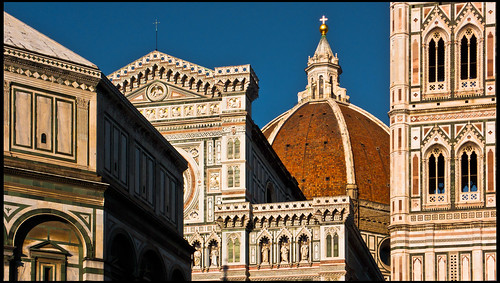
The walls of the buildings around the piazza diffused the afternoon sunlight so that it flowed over the cobblestones, gilding them with that spectrum of light that is so uniquely Tuscan. The sun's rays spilled over my skirt, drawing me into the picture-perfect Florentine afternoon as though I belonged there.

I smiled to myself as I wrote my postcards, pausing often to look around the piazza and bask in the October sunshine, happy just to sit and enjoy the afternoon while my friends explored a museum I hadn't had energy left to gear myself up for after spending hours at the Cattedrale di Santa Maria del Fiore and the Galleria dell'Accademia.

An elderly gentleman walked into the square and took the seat adjacent to mine on the circular bench where I was writing. After several moments, he spoke and, since I was the only one around, I looked up and said "Scusa?" He repeated himself, gesturing toward me, then tapping his left arm. I caught the word sinistra and assumed he was commenting on the fact that I was left-handed, so I nodded. My limited Italian didn't offer any clues about his next statement, so I shook my head and said, "Non parlo italiano, signore, scusami." He grimaced, nodded and went back to watching the few people wandering through the piazza. Two or three minutes later, I saw the man turn back toward me out of the corner of my eye and heard, "Parlez-vous français, mademoiselle ?" I turned toward him, grinning, and said, "Oui !"

We spoke about trips he'd taken to France, how I was enjoying my second visit to Florence and how much I had loved San Gimignano on a trip a few years before. When I mentioned that I was actually American, not French, he told me he thought it was wonderful that I was taking advantage of my youth by traveling. It's impossible not to learn something new about life when we travel, he told me, and learning about life is how we come to know ourselves and the people around us. As he got up to leave, he took my hand in a warm, strong grasp that reminded me of my grandfather's and asked my name. "Enchanté, Jessalyn," he said, "Je m'appelle Antonio."

I spoke with Antonio for no more than ten minutes on that afternoon in Florence, and our paths haven't crossed since. I don't know what made him think to ask if I spoke French - if he saw the postcard to my French host mother, or if it was just a hunch. But the truth of what he said has stayed with me and, whenever I think of Florence, the first thing that comes to mind is a man named Antonio and the advice he gave me on a sunny October afternoon.

Tuesday, October 12, 2010

Profiles in Transit: Teaching Italian by Impatience

Courtesy of McLoy2008, Creative Commons
Italy, the second stop my parents and I made during my first trip out of North America at 15, was my first experience spending time in a country where my only knowledge of the language was whatever I could find in the phrasebook. I refuse to ever start a conversation by addressing someone in a language other than their own, no matter how pathetically, so I had learned the basics: Buon giorno ("Hello"), Parla inglese o francese, per favore? ("Do you speak English or French?"), Vorrei... ("I'd like..." - when in Italy, being able to order the amazing food is critical.) and some other basics, like counting to ten, please, thank you and the omnipresent scusi, for getting through crowds at least semi-politely (which, I realize, is completely un-Italian).

Throughout Florence and San Gimignano, my limited Italian worked beautifully. Someone always knew enough English or French to talk to me after I gave them my standard greeting, and my food vocabulary increased by leaps and bounds, supplemented with great words like cinghiale - wild boar. Fun to say, although my dad enjoyed the actual eating of it much more than I did.

On the train to Sorrento by way of Naples, however, I hit a linguistic wall in the form of a Trenitalia employee. I had wandered into the dining car in search of some water and approached the bored-looking woman behind the counter with a smile.

"Buon giorno!"
She nodded in return.
"Parla inglese, per favore?"
She gave a brief shake of her head and half arched a brow at me, as if to say "Why would I? And now what are you going to do, ragazza?"
"Parla francese...?"
Another head shake. Hm. Well, I'd seen enough ads for bottled water, maybe I could do this.
"Vorrei...una...um...una bottiglia di acqua? Per favore? Naturale, per favore? ("Can I have a...um...a bottle of water? Please? Still, please?")

The woman gave me a look that said, "If it didn't take so much effort, I would roll my eyes at you. Why did you ask me to speak two other languages?" and rang up the water before muttering the total at me. I paid, said "Grazie!" and sped back to my seat to tell my parents I'd spoken a whole non-pasta-related sentence in Italian.

That Trenitalia employee, sullen though she may have been, taught me a lesson that's come in handy many times over the years: it's when under pressure to communicate that you realize the full extent of what you know. That's the premise of language education by immersion: you subconsciously absorb the language you see and hear and, when given no option but to use that language to communicate, your subconscious shoves it into your conscious mind. Terrifying as it can be, it works. Even on Italian trains.

Wednesday, September 22, 2010

Profiles in Transit: Patience at la Tour Eiffel

The people who sit in the information booth at the Eiffel Tower must have one of the most exhausting jobs on the planet. People storm the booth in droves, asking questions in broken French and a myriad of languages from around the world, the answers to most of which they could find by simply reading the signs posted around the plaza at the base of the monument. Or by turning to the right page in one of their six dozen guidebooks.

The Eiffel Tower was one of my first stops in Paris on my first trip there with my parents. I was 15, and had recently finished third-year French as a freshman in high school, so my mom sent me to ask her question. I formulated it carefully in my head as I walked toward the information booth, and was encouraged when the man in the booth smiled at me as I stepped up to the window. "Bonjour," I said, pleased when his smile widened a bit and he responded in kind.

I don't remember what the question was, but I asked it and he answered - slowly, but without being too obvious that he was taking extra care with his enunciation. I said "Merci!" and sauntered back to my parents with the answer, proud of myself for understanding it. My mom remembered another question she wanted to ask and sent me back...then remembered a third question when I came back with the answer to that one. I was embarrassed to be back at the information booth's window again so quickly, but since the man inside was still smiling when I arrived for the third time, I fumbled my way through the last question - the trickiest, making use of some of the complex grammar I had just learned - and the man patiently waited for me to finish, then repeated his answer twice when I wasn't certain I understood after the first time. I thanked him again and joined my parents to make the climb to the top.

I never got the name of the man who was working in the information booth that day, and I have only a vague memory of his face - maybe early 30s, on the pale side, brown hair and a medium build - but, 10 years later, I still think of him often. Whenever someone complains about how rude Parisians are, how they never let you finish a sentence in French without interrupting to tell you to continue in English, how they're insufferable when it comes to helping English speakers, I remember this man. At one of the most popular attractions in Paris, he was patient enough to let me stumble through my limited French not once, but three times. As busy as he was on a tourist-filled June morning, he was careful to speak slowly enough for me to understand every word. His kindness, his patience and his smile are what I've come to expect when traveling through France, and I have yet to meet with anything less. And when I see struggling tourists in a city where I feel at home, I try to offer them assistance with the same attitude that man showed me: patience, and a smile.

Friday, September 17, 2010

Profiles in Transit

My mom is fond of saying that, on my first big trip abroad, I looked at every monument, every piece of living history, as though I hadn't been certain it really existed until the moment I saw it with my own eyes. It did feel something like that: I felt the huge smile spread over my face the moment I saw the top of the Eiffel Tower as we walked toward it along the Seine; I stared in disbelief at the mosaic of a dog with the words "Caveat emptor" beneath it embedded in a floor in the ruins of Pompeii, an image I'd seen hundreds of times in my Latin textbook; I watched the wooden steps passing beneath my feet as I climbed the Arc de Triomphe, wondering about all the feet before mine that had worn them smooth.

I goggled at the places I went and the things I saw, but it was the people I met - however briefly - who left the deepest impressions. For me, one of the best things about traveling is the map of memories it creates. I can look at a picture of somewhere I've been, or pinpoint a trip on a map, and remember the interactions I had with the people there, whether or not I spoke their language or they mine with any fluency. Those memories bring back the feel of a place: the scents of the market, the sounds of the traffic and the language filling the air, the textures of the streets and buildings, the tastes of the local food. And it's in remembering those details that I can travel back, at least in mind if not in body, to the places and people I've so enjoyed.

These "Profiles in Transit" will help me chronicle the people I meet and, hopefully, will give you a window into some different cultures, whether or not they're ones you've visited yourself.