Showing posts with label people. Show all posts

Tuesday, May 31, 2011

Profiles in Transit: Pau Thom

Siem Reap, Cambodia
"Hey lady, where you from?" echoed off the buildings on either side of the narrow alleyway as I turned down it and two boys no more than ten years old fell into step with me. Used to the rhythm of this exchange after two days in Siem Reap, I said "The U.S. - California" and kept walking, knowing they'd keep pace.

Sure enough, the boy who'd greeted me rattled off President Obama's name, the U.S. and California capital cities, (former) Governor Schwarzeneggar's name and even a couple of quotes from the Terminator movies. I laughed and kept walking.

"Hey lady, I remember you, I talked to you yesterday!" the boy said, unexpectedly. I stopped and looked at him, then smiled. "You're right, I remember you too!"

"So today you buy my postcards, eh? Yesterday no, but today yes?" I looked at the cards but realized I had bought the same set the day before outside Angkor Wat's Ta Prohm, from a girl no more than five years old who broke my heart when she said she hoped I would buy her postcards because she wanted to go to school.

"I'm sorry, I already have these ones," I said, feeling regretful and wondering if I should buy a second set - I genuinely liked this kid.

After a brief pause, he said, "I'm still hungry today, maybe you could buy me some food instead?" My heart cracked again and, after my own brief pause to consider the idea, I said, "Sure, what do you want to eat?"

"This way, I'll show you," he said, leading me down another alley and making me momentarily consider the potential folly of following a stranger - even a friendly, juvenile one - through the streets of a Southeast Asian city I didn't know particularly well.

"My name is Pau Thom," he said, practically skipping as his friend and I walked alongside, "what's yours?"

"Jessalyn," I answered, pronouncing it slowly.

The Siem Reap alleyway Pau led me down
(which, consequently, I'd taken a photo of an
hour earlier) in search of his favorite chicken amok.
"Jessalyn," he repeated (more accurately than most Americans, to be honest) "Okay, now I remember your name and we can play! I remember you when you go back to California."

I laughed and restrained the urge to rumple his hair as I would have done to my niece. "And I'll remember you whenever I think about Siem Reap."

We grinned at each other as we crossed a street and approached a small restaurant with tarps pieced together serving as a roof and a plastic-coated menu sitting on a rickety pedestal outside. Pau flipped through it, then pointed to a chicken amok dish. "That's what I want to eat."

"Okay," I said and asked the waitress to bring him an order of the dish, along with a Coke when he said that was what he wanted to drink. Pau's friend slipped away before I could ask what he wanted, but Pau got settled at a table and I paid the waitress for his meal (which cost all of $3.00, U.S.). He looked small and more than a little lost at the four-person table by himself, completely out of his element - happy about it in some ways, since he was clearly hungry, but not quite sure what to do with himself while he waited for his meal. I wanted to sit and keep him company but was already past the time I should have been heading back to my guesthouse to finish packing and head to the airport, so instead I told him I had to leave. He gave me his crooked, sunny smile and waved, "Bye, Jessalyn-California!"

I smiled and waved back, murmuring "Bye Pau," knowing I was leaving a little piece of my heart behind as I walked away, but glad to carry the memory of that crooked smile and sunny disposition with me as I moved on.

There are hundreds of children in the same position as Pau on the streets of Siem Reap and Angkor Wat, not to mention thousands throughout the rest of Cambodia. Some of them are bitter after years of watching foreigners come and go who are never hungry and don't lack for anything; most of them are resigned; and some of them, like Pau, are cheerful despite the hardships they face and, whether they know it or not, bring smiles to the faces of the people they interact with every day. Some people may question my decision to buy Pau a meal and that's fine - for me, it was a way to help that didn't involve simply handing over money (which, once I'd declined to buy his postcards, he didn't ask for anyway), since that's something I try not to do. Pau made my day significantly brighter and I hope that I was able to do the same for him in some measure.

My one regret is that I didn't get a picture of that cheerful, charmingly crooked smile of his. I'm still painfully shy when it comes to asking people I meet while traveling if I can take their picture and, while it doesn't affect my memories, it does have an impact on the degree to which I can share those memories with you. Hopefully by the next time I meet someone like Pau, I'll have overcome my shyness enough to ask if I can take a quick snapshot to remember them by.

Wednesday, March 2, 2011

Australian Adventures: One Month In

Predictably, I petted my first one of these guys
before I'd been here a week.
Somehow, a month has gone by since I arrived in Sydney. A month ago Sunday, to be exact, since I started hearing "no worries" six times an hour and blinking in confusion at everyday expressions like "How're you going?" and "D'you want cash out?" It feels like I've been here both much longer and much less than a month. Longer because I've already done so much and I feel settled in; less because how could I possibly have been gone a whole month already?!

I didn't quite know what to expect from Australia. I'm a foreigner, but one who shares the same native language, albeit with a different national bent. I'm a student, but an international one whose studies take place at least half the time in a language native neither to this country nor to my own. And I'm a traveler, looking forward to learning the ins and outs of this country that is my temporary home. Where would I fit in, in Australia, on campus, in class, I wondered? Australia, with its laid-back sense of welcome, seems to say "fit in wherever you like, mate!"

That's one of the things I'm slowly realizing is a big part of what makes Australia so appealing: its unquestioning acceptance of whoever happens to show up. Sure, you have to certify that you're not a criminal and aren't trying to wipe out any of the native species to get through immigration but, once you're in, the welcome is universal. It isn't overpowering or over-eager, like a scene in a musical where every member of the cast is dancing with manic joy in the middle of the street; it's a casual "Hey, how're you going? Glad you could make it," that's extended to everyone from the man who's lived around the corner all his life to the tourist who arrived yesterday and is still fumbling with the currency.

Do I look relaxed yet?
Every single person I've met in the past month has emanated this casual acceptance and welcome. The cashier at the local Woolies (Woolworths, an Australian grocery store), who took in my bleary, jet-lagged confusion when she asked if I wanted cash out (that's cash back, for my fellow Americans) on my first evening here, put it together with my non-Aussie accent and welcomed me to the area with a smile. The waitress at Hobart's Retro Cafe who saw my Arizona driver's license as I pulled out my wallet, thought it was the coolest thing she'd seen all week and wanted my opinion on what Aussie English sounds like to American ears (charming, is the answer!). Not to mention the multiple bus drivers who have kindly advised me that the bus to my desired destination is the one that arrives on the opposite side of the street and haven't seemed at all put out at having stopped for a passenger who turned out not to be one.

The first country other than my own that I lived in long-term was France, for which I fell head-over-heels instantly, swept off my feet by the rich colors, textures, scents and sounds of everyday life, so different from what I grew up with in the U.S. Australia is more subtle - less intense, more easy-go-lucky and much less passionately opinionated - but no less convincing. Already, I find myself relaxing in a way I rarely did in the U.S., not just on the surface but right down to my bones. Despite the fact that classes are now in full swing, stress is becoming a distant memory. "No worries," which you can't help but hear every day in Australia, isn't just a phrase, it's a way of life, one that seeps into every pore and which, I have a feeling, may be impossible to get rid of once it's made its way into your system. Then again, why would you want to?

Thursday, January 13, 2011

Americans in Florence: Obnoxious vs. Incognito

No logos or flags here!
Like many travelers, I do my best to blend in on the road. I don't actively hide the fact that I'm American and if anyone asks where I'm from, I'll tell them (although I'll probably make them guess first), but neither do I advertise my nationality. I don't wear shorts or hoodies in Europe, I don't wear American flags or baseball caps emblazoned with the logo of a U.S. sports team, political organization or school and I certainly don't wave my passport around. I speak as much of the local language or dialect as I can and try to learn the customs out of respect for the people who live by them, not to mention in hopes of leaving a positive impression behind for the foreign visitors, including my fellow Americans, who arrive after me. So when I see Americans doing exactly the opposite, flaunting their nationality, completely ignoring local customs and speaking - loudly - in American-accented English, it never fails to make me grit my teeth in frustration.

I ran into one such group of Americans in the middle of fall break during my year abroad. Four of us had traveled together to Florence for several days and we were splitting up - two of us heading to London and the other two further south in Italy - the next morning. We'd had a wonderful time in Florence and wanted to celebrate our last night en vacances together with a nice dinner, so we found a place in the heart of the city and sat down, rubbing our hands together in greedy anticipation of more delicious Italian cuisine.

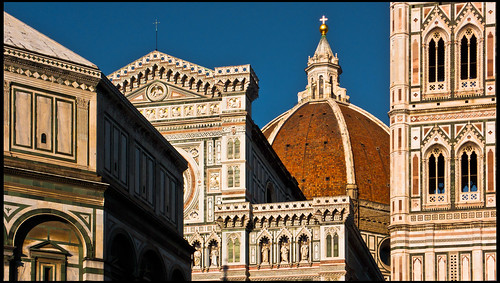
I went to Florence to see things like Il Duomo, not to hear
tourists arguing with each other at the top of their lungs.
Since the four of us were all enrolled in the same study abroad program, one that required its students to speak French 100% of the time, we had decided at the beginning of our trip not to fall out of practice on vacation. ("Practice" aside, we'd learned during recent parental visits that our various regional accents in English made it nearly impossible for any of us to complete a sentence without at least one of the other three bursting into a fit of laughter. With friendships formed in French, we just sounded too strange to one another in English to make it practical.) I felt far less visible as a French tourist than I ever had as an American, and I was enjoying it.

The table of girls seated behind us at the restaurant, however, clearly had no such reservations. They chattered away in English, much more loudly than was necessary, and my friends and I rolled our eyes at each other and wondered why Americans so often seemed unaware of the volume of their voices in comparison to the people around them. Did we do that when we spoke English, we wondered? What was it in American DNA that demanded our conversations be loud enough for everyone around us to hear?

Street art, Firenze-style! (And no one can knock this one
against the wall...)
As we talked, the painting that hung over our table began to rock against the wall at random intervals. We looked up in confusion and realized that it stretched the length of the wall our table was against, meaning it also hung above the table of the girls behind us. One of them had the back of her shoulder leaned against the bottom edge of the frame and every time she moved, so did the entire ten-foot-long painting, to which she and her friends were apparently oblivious. We tsked under our breath and went on with our conversation, but finally one of my friends seated against the wall couldn't take the constant nudging of the painting anymore. After a quick consultation, during which we decided the girl seemed the type to tell another American student to mind her own business, my friend turned around and said, in a heavily French-accented voice, "Excuse me, ze painting? It moves."

The girl gave her such a disgusted look that I nearly burst out laughing, but my friend returned her glare levelly and the girl finally shifted her shoulder away from the wall, then turned and started muttering - not quietly - with her friends about what a pain the French people behind them were. We snickered under our breath and dug into our dinner.

Just for the humor quotient, those few moments in Florence remain one of my favorite memories of that trip, but the memory of the dichotomy between two tables of American girls keeps me mindful of my actions and my attitude whenever I'm traveling. Whether I'm speaking another language and not obviously American to anyone but customs agents or revealing my nationality with the pronunciation of every word out of my mouth, I'm conscious of doing whatever I can to blend in and respect the local culture.

Certainly not all, or even most, Americans are as oblivious to their surroundings or as rude to the people around them as those girls were, but the reputation Americans have as obnoxious tourists in much of the world is due to those like them. The poor attitudes and lack of respect of that minority have painted the rest of us with the same brush and overcoming the negative impressions they've left behind can be challenging. That's why, whenever anyone asks my advice about traveling, manners, following local customs and paying attention to your surroundings are at the top of my list. As an "obnoxious American," I'd never get anything like a real look at what life is like around the world - and that's too much a part of the reason I travel to miss.

Wednesday, December 22, 2010

Why travel?

Angels Landing from the valley floor,
Zion National Park, Utah, USA
To people who haven't been bitten by the travel bug, the desire to fly, drive, walk or sit on a train for hours just to go look at streets, buildings, trees and people in a different city, state or country can seem baffling. Why go all that distance to spend time outside your comfort zone, around people you may not be able to understand, in a place where it may not be safe to drink the water or eat certain types of food and where you're not unlikely to get lost at least once a day? Why sit on a rattling bus overnight, or trek through bug-infested forests up to altitudes that make you light-headed? Why bother with all the hassle and headaches of traveling, when you could stay comfortably at home?

If you asked 50 travel junkies those questions, you'd likely get 50 different answers, but I'd be willing to bet that most of them wouldn't be all that different from mine, at least in spirit: Because, in getting lost, you'll stumble over people and experiences you didn't know were missing from your life. Because finding a way to communicate with people who live a world away from where you grew up shows you just how how much you have in common, despite the differences in your lifestyles and looks - and because those differences can open your eyes to new ways of doing things, or make you better appreciate your own life. Because beauty - in architecture, in nature, in people - is worth seeking out. And because nothing is more exhilarating than stepping over the edge of your comfort zone and free-falling into as-yet unknown experiences.
Les arènes: Inside the Roman amphitheatre,
Arles, France.

Travel can be terrifying. If you venture away from home often enough, there will inevitably be moments when you want nothing more than to be back where things are simple and figuring out how to interact with the people around you without offending anyone or making a mockery of yourself doesn't take every ounce of brainpower you have. You will likely get sick or hurt at inopportune moments, be scorned by locals who think you should have stayed at your home and well away from theirs, and wonder, once you're past the point of no return on some adventurous outing that required you to sign away the operator's liability for your life, what the hell you were thinking.

Those moments, however, are few and far between and almost always make you laugh at some point down the line. Most of the time, travel is wonderful. You can admire the colors in a national park and wonder just how long it took for such beauty to be carved out of the earth. You can stand at the Pont du Gard or the Roman amphitheatre in Arles and marvel at how such huge constructs have stood for so long without mortar. You can take a walk or a hike and wonder about the thousands of other feet that have been there - who they belonged to, what those people saw, their reasons for coming. You can exchange a smile with someone who was raised in a culture radically different from yours and treasure a brief conversation that you'll never forget. Or you can sit, at a café, on a park bench, on a curb, and watch the world go by, with all its similarities to and differences from the world you know.

Looking back down the path to Inis Mór's
Dún Aonghasa, toward the Irish Sea.
As long as you mind your manners and respect local customs, there's no wrong way to travel. Whatever it is that you're looking for, whatever your reasons for going, as long as you're satisfied with what you see, do and experience, you're traveling the "right" way. For some, that "right" way means setting out on an epic adventure without an end date, while for others it's a long weekend close to home or a week a short flight away.

Travel is personal, with a lot of self-discovery wrapped up in any trip, but whether you travel alone, with friends or with a group, it's also something to be shared. Each new memory you make expands your view of the world and every experience you have can be helpful to the people around you, those you already know and those you have yet to meet.

So, why travel? Pick a reason, there are hundreds. I think a more difficult question to answer is "Why not travel?" I can't think of a single answer that isn't outweighed by the benefits of travel and the discoveries it yields. Can you?

Saturday, December 18, 2010

Getting Hustled in NYC

Um, I'd like to keep that in my wallet, please.
Creative Commons, TheTruthAbout
In general, I think I'm a pretty good judge of character and - essential to a traveler, especially a woman who often travels alone - I pride myself on trusting my gut. So far (knock on wood) I've been lucky enough and smart enough to avoid any trouble while traveling abroad. But my ego took a huge blow this fall when I got hustled in New York City.

I was only in New York for about 36 hours, just long enough to eat some pizza, people-watch in Times Square and along Broadway, help out at the gala event for work that was the reason I was there, grab some bagels and head back down the Turnpike to our office in Washington, DC.

When I walked into the gala venue, I was in a great mood. I hadn't been in a major city in going on three months, and I was riding the high of the energy boost I always get the moment I arrive in a city I love. I've been tele-commuting since May, so it had been a while since I'd seen my co-workers and seeing friendly faces I'd missed was another rush. I spent the evening working at the registration table, talking literature and nerve-wracking visa applications with the Polish woman working the coat check for the catering company in between checking in guests.

It was about an hour into the event when a man hurried over to the table, set down his glass of wine and asked if I had any change; he had to go pay for parking and he didn't have any small bills. I'm usually terrible at carrying cash and all I had was the single bill I had tucked into my purse, just in case. "Sorry," I said, "all I have is a $20." Talking so fast that I could barely keep up (and that's saying something: I'm from Southern California, where I grew up talking so fast that my dad would often shake his head and tell me to slow down during family dinner conversation), the man said that was fine, he was just short and needed to pay ASAP, so he'd run to the ATM on his way back from the garage to pay me back. He tossed in the name of one of my organization's board members, saying he was a friend. I was uncomfortable and wished I'd kept my mouth shut about the $20, but told myself I was being ridiculous - he was a guest who needed to borrow some cash, that was all. I pulled out the $20, handed it to him and watched him keep up the same frantic pace as he headed out the front door, tossing a "Thanks" over his shoulder.

About twenty minutes later, my gut was telling me that this guy was not coming back, and I was berating myself for breaking so many of my own rules about dealing with strangers:
  1. Listen to your instincts, not the person's appearance. The guy was wearing a suit and tie, so my brain said, "Honey, look at him, it's fine," even while my instincts were screaming "Bad news!"
  2. He used a nickname for the board member he claimed to know that I'd never heard him called by. It had the intended affect of making me think the guy just knew our board member better than I did, even while it set off alarm bells in the back of my head.
  3. When someone's talking very quickly and not quite making eye contact, they're not up to anything good. Based on this guy's behavior, I'd say that rule #1 in the Hustler's Handbook is "Never stop talking, never stop moving, or it'll give them a chance to think."
  4. Do NOT tell people that you have cash. My automatic response to people on the street who ask me, specifically, for money is "I'm sorry, I don't have any change." (Which is usually true, but that's beside the point.) This is where broken rule #1 came in, which, combined with the fact that I was surrounded by hundreds of people, many of whom I knew, made me feel safe enough to confess that I didn't have what I thought he was looking for in a little too much detail.
  5. He wasn't consistent about what he wanted. First, he needed change. Then, when I didn't have change, he was short. Alarm bells clanging all over the place, and I still let myself be blinded by #1 and steam-rolled by #3.
An hour later, I was furious with myself. $20 wouldn't have bought me much, but it was enough to make a difference in my budget for the week. At the end of the event, I told my co-workers what had happened, struggling to look at it as a lesson well-learned at a time when the loss of $20 didn't leave me desperate - but it still stung. It turned out that one of the cater-waiters had also been hustled, and our bookkeeper was kind enough to reimburse both of us and consider it part of the expense of the event.

I was very grateful to have the $20 back in my purse, but was still upset with myself for being such an uncharacteristically easy mark. (And, really, at an event that costs hundreds of dollars per ticket, who hustles the event and catering staff?! Probably someone who knows that New York society is too smart to fall for their lines...) But I've learned an important lesson, with injury to nothing but my ego: even in what you consider a comfort zone, don't let your guard down completely and always trust your gut.

Tuesday, December 14, 2010

The Secret of Life

As individual as each of us is, as much as we insist on making our own way and living our own lives, we always have preconceptions of what's "normal" based on the opinions of the people around us and the status quo as we were growing up.

College graduation, May 2007.
For me, this moment felt like
a given, but that isn't the
case for everyone.
In my hometown, an affluent beach suburb that prides itself on the quality of its schools and the achievements of its students, going to college isn't a question for most people. There, a college education is perceived by most as a necessity, a stepping stone to adulthood and a life of purpose, whatever that purpose may be. I never questioned that I would go to college, and the fact that neither marriage nor children were part of my plan until, at the very least, a few years after I had finished that bachelor's degree seemed like the most normal thing in the world.

So when I was asked last week what my "secret" is for being 25, unmarried, fairly well-traveled and about to start my graduate work, my first reaction was to blink in surprise, speechless. But I don't have a secret, I thought. Isn't that pretty normal? With the possible exception of the well-traveled part for some, I don't think my situation is all that different, on the surface, from that of a lot of 25-year-olds around the world.

Then I started to put the question into context: I'm not in an urban area anymore - in fact, I'm a three-hour drive from any major city. This part of Arizona, which my parents moved to when I was a sophomore in college, is rural, much of it is far from affluent and many of the schools struggle to get a decent percentage of their students successfully through the state-mandated testing. Some of the kids who grow up here do go on to one of the state's public colleges, but for many of the people who live here, a college degree may as well be the moon. And most people are married and starting families by their early 20s. In my seven months here so far, I haven't met or heard of anyone else my age who isn't married.

The man who asked my "secret" for living my life as I have has two young daughters, whom he wants to see get their degrees and explore the world; he and his wife are planning a family vacation overseas when they're a little older. In this area, as in a lot of the U.S., making a trip like that is a big deal and I was touched by this man's concern for his daughters' future and his desire to show them that a life that is "the norm" for this area isn't their only option.

After my initial surprise at his question, I started to think about what pushed me to study and travel as much as I could. Yes, some of my motivation for getting my degree was because it was expected, but I was genuinely interested in the subjects I chose to study and I enjoyed spending time on them, years of sleep deprivation aside. Studying abroad was something I felt compelled to do, if time and money allowed, and I don't regret a moment of it, despite the fact that it made my last year of college extremely hectic. When I started my bachelor's degree, I didn't think much about grad school, but as my interests have developed, it's become clear that the path I hope to follow into the future will be more accessible with a Masters degree - and I'm lucky enough to be able to work toward that new goal while indulging my love of travel. So it seems that having a passion for something - or several things - and the drive to pursue it is my "secret."

While the ideas of normality that each of us grow up with will never entirely fade, they don't define our lives unless we let them. (And one sure way to blow any idea of "normal" out of the water is to travel and see how different life is for people around the world.) I think Caecus got it right when he said, "Each man is the architect of his own fate." I believe that, and, though the path I'm following may be influenced by other people and may change direction, I will always be the one making the decision to change course or continue straight ahead - no one else can decide my life's direction for me. What's your secret to living the life you want?

Sunday, November 28, 2010

Saturday Snapshot: Get Lost in the Crowd


Call me crazy, but I love crowds. Not the shoulder-to-shoulder, shuffling-an-inch-at-a-time, can't-breathe-without-inhaling-your-neighbor's-hair kind of crowd, but the kind you find in most big cities, that pulses with the energy of everyone in it, pushes you to walk a little faster and says "Okay, what are we going to do today?"

That energy is one of the first things I notice about a city and, if one doesn't have a distinct feeling all its own, it's a good indication that I'm probably not going to like it much - not a problem for London, the location of this week's Saturday Snapshot.

This photo was taken from the steps of The National Gallery, overlooking Trafalgar Square, in late October 2005, when I was visiting London with a friend during the second half of our October break. We were only there for a few days and had slightly different to-see lists, so we decided to spend most of this day separately. Predictably, I spent a lot of it wandering the city streets, soaking up the atmosphere. After two months in relatively small Aix-en-Provence, being back in the rush and bustle of a large capital city with crowds of people on the streets felt like being a kid in a candy store. Everywhere I looked, there were interesting things to see: people, stores, taxis, landmarks, other tourists.

It was mid-afternoon by the time I reached Trafalgar Square and I was starting to drag a little, probably because I'm prone to forgetting lunch when I'm exploring a new place. I wandered through the square, then joined the crowd on the steps of the museum and just sat for a while, people-watching and snapping photos, happy to be part of the crowd.

Tuesday, November 9, 2010

Tales from a Hostel Bunk: Prague

I walked into the four-bed room and frowned. Nothing had changed since I'd swung back to the hostel to drop a few things off mid-afternoon: there was still only one bed other than mine occupied, and the things on it still didn't look the least bit feminine. Coed dorm rooms, as long as they were small, weren't so bad, but me and just one guy, in a room at the end of the hall? That was a little weird, and potentially creepy.

The Astronomical Clock in Prague's Old Town Square,
a 10-minute walk from my hostel and one of my
favorite parts of the city.
My roommate of the night before, a very sweet British-American woman a few years older than I was who had been teaching English in the Czech countryside for two years, had left to catch a flight before dawn. The pair of American guys, also on spring break, with whom I'd shared a van from the airport to the city center the day before and who had turned up at my hostel after realizing the one they'd booked was a disaster, were apparently already out for the evening. Since breakfast had revealed the other occupants of Apple Hostel to be mostly quiet pairs who didn't make eye contact, I wondered what other solo traveler had shown up. And hoped he was short, with less muscle mass than your average 12-year-old.

Don't get me wrong, meeting other travelers is the best part of staying in a hostel, but the idea of sleeping in a room with an unknown man and no one else had my internal solo female traveler alarm clanging a warning. I try to stay in female-only rooms whenever possible, but Apple Hostel didn't have any rooms designated as such for the time I was there.
My first full day in Prague, during the boat portion
 of a walking/boat tour of the city center, with Karlův Most,
Malá Strana and the Hrad behind me.

A key turned in the lock while I was contemplating putting my shoes back on to head out for an hour at a café before dinner, and I bargained with myself: if he set off any "creepy guy" signals in my head, I'd ask about switching to another room, but it was unfair to judge a fellow traveler without even exchanging a few words of conversation. I took a deep breath and fixed a cautious smile on my face as the door opened.

Rather than short and frail, my new roommate turned out to be a tall German with a proclivity for skiing, mountain climbing and hiking. Oops. But he also seemed to tune in quickly to the fact that I wasn't entirely comfortable and set about making casual conversation. We discovered common interests in our mutual love of the outdoors and languages (although his near-native English was light-years beyond my limited German), and spent a pleasant hour talking about places we'd been and others we hoped to visit. We didn't spend much time together during the few overlapping days of our respective stays, but he was a pleasant roommate and seemed careful to respect my personal space and to avoid doing anything that might make me nervous, which I greatly appreciated.

I loved all the colors used in Prague's architecture, like on
these buildings, seen through an arch of Karlův Most.
I can't say the experience made me any less wary of sharing a room with a solo traveler of the opposite sex, and I still look first for female-only rooms when I'm traveling alone. But sharing a room with a solo male traveler who turned out to be one of the most respectful, polite and easy-going guys I've ever met was a good reminder that, while it pays to be on your guard when traveling - solo or otherwise - you never know who you'll meet or what interesting conversations you might have if you give the people around you a chance.

(For those curious about Apple Hostel itself, it's a decent-enough hostel within walking distance of both Wenceslas Square and Old Town Square. The rooms are clean and spacious; the only thing that made me a little nervous was that the top bunks didn't have rails around them or anything to keep people sleeping there from falling out. The breakfasts provided when I was there were fairly stale and I preferred to seek out my own. The communal bathrooms were kept in decent shape, although the showers were slow to drain and the shower setup will give Americans pause: three beach-style shower heads along one wall of the shower room, with no dividers between them or between that section of the room and the sinks. I'd stay there again because of the location, but if I found something in the same price range that seemed nicer or more welcoming, I wouldn't hesitate to try that instead.)

Wednesday, November 3, 2010

Profiles in Transit: Antonio

Creative Commons, guillenperez
The walls of the buildings around the piazza diffused the afternoon sunlight so that it flowed over the cobblestones, gilding them with that spectrum of light that is so uniquely Tuscan. The sun's rays spilled over my skirt, drawing me into the picture-perfect Florentine afternoon as though I belonged there.

I smiled to myself as I wrote my postcards, pausing often to look around the piazza and bask in the October sunshine, happy just to sit and enjoy the afternoon while my friends explored a museum I hadn't had energy left to gear myself up for after spending hours at the Cattedrale di Santa Maria del Fiore and the Galleria dell'Accademia.

An elderly gentleman walked into the square and took the seat adjacent to mine on the circular bench where I was writing. After several moments, he spoke and, since I was the only one around, I looked up and said "Scusa?" He repeated himself, gesturing toward me, then tapping his left arm. I caught the word sinistra and assumed he was commenting on the fact that I was left-handed, so I nodded. My limited Italian didn't offer any clues about his next statement, so I shook my head and said, "Non parlo italiano, signore, scusami." He grimaced, nodded and went back to watching the few people wandering through the piazza. Two or three minutes later, I saw the man turn back toward me out of the corner of my eye and heard, "Parlez-vous français, mademoiselle ?" I turned toward him, grinning, and said, "Oui !"

We spoke about trips he'd taken to France, how I was enjoying my second visit to Florence and how much I had loved San Gimignano on a trip a few years before. When I mentioned that I was actually American, not French, he told me he thought it was wonderful that I was taking advantage of my youth by traveling. It's impossible not to learn something new about life when we travel, he told me, and learning about life is how we come to know ourselves and the people around us. As he got up to leave, he took my hand in a warm, strong grasp that reminded me of my grandfather's and asked my name. "Enchanté, Jessalyn," he said, "Je m'appelle Antonio."

I spoke with Antonio for no more than ten minutes on that afternoon in Florence, and our paths haven't crossed since. I don't know what made him think to ask if I spoke French - if he saw the postcard to my French host mother, or if it was just a hunch. But the truth of what he said has stayed with me and, whenever I think of Florence, the first thing that comes to mind is a man named Antonio and the advice he gave me on a sunny October afternoon.

Wednesday, October 27, 2010

Bright Lights, Big City

By Brian Solis (b_d_solis), via Creative Commons
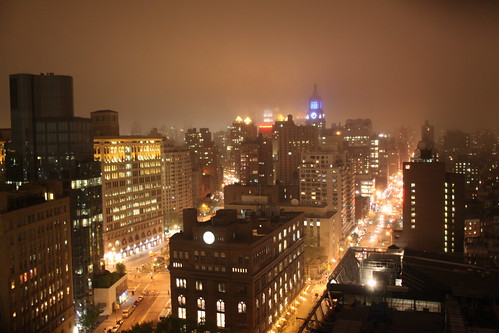
The first time I went to New York City, I hated it.

Well, maybe that's a little strong: I was completely overwhelmed by it. I grew up in a laid-back beach suburb of Los Angeles where the surfers far outnumbered the taxis and the tallest building was the water tower. I'd been to Paris, Florence and Washington, DC but none of them had prepared me for the sheer energy of NYC. Whereas Washington carries a feeling that something's in the wind, that you shouldn't underestimate what you can accomplish, New York is in your face, electric and somehow determined. New York isn't hoping it can do something big; it knows it's going to.

I enjoyed parts of my first trip to New York - visits with my family in Brooklyn and Manhattan, the American Museum of Natural History, glimpses of Central Park - but the main reason I was there, as a rising high school senior, was to look at NYU. The information session was crowded and impersonal and, despite the school's impressive programs, nothing about it spoke to me. Thinking about the crush of people outside and the few school flags I'd seen flying from halfway up tall buildings, I didn't see how the students could connect with one another in such a maze. Did person-to-person interactions all take place nine stories above the sidewalk? I didn't stay for the campus tour.

My next trip to New York was five years later, after I'd gone to college in Washington, studied abroad and generally become much more comfortable with city life. That time, I couldn't drink in the atmosphere fast enough.

I strolled across the Upper West Side, people-watching and browsing street art. I explored the exhibits at the Met and wandered through Central Park. I stopped to watch rollerbladers put on a demonstration and made my way to H & H (after searching through half a dozen books in the Met's bookstore for the address) to sample a bagel.

In the past three years, I've spent more time in the Big Apple than 17-year-old me ever dreamed I'd want to - a week, a weekend, sometimes just a day - and every time I leave, I wish I had just a few more hours. I love the crush of Times Square, the sidewalks overflowing with people and stuff for sale in Chelsea and the fact that I can walk as fast as my legs will carry me throughout the city and no one will look at me like I'm crazy (which is not the case in the South Bay, where the California stroll is king). I've eaten enough New York pizza and pasta to feed a large Italian family for a month, wandered Rockefeller Center after dark, sipped frozen hot chocolate at Serendipity 3 and walked across the Brooklyn Bridge into lower Manhattan, eavesdropping on conversations in a myriad of languages.

Rather than overwhelm me and make me want nothing more than to crawl into bed, preferably in a dark, sound-proofed room, New York's hustle and bustle has become infectious, making me want to dive into the thick of things and fully experience all the city has to offer. It's a city where everyone jockeys for their piece of the action and diversity is celebrated, not seen as an oddity. In a world that all too often looks for homogeneity, New York is a bright flash of individualism, to the nth degree, that can capture anyone's imagination - you just have to find the right angle.

Saturday, October 16, 2010

Blog Action Day 2010: Blogging for Clean Water

Most travelers are used to conducting at least some parts of their lives non-traditionally. In exchange for giving up a permanent place of residence, taking a career break, living out of a suitcase or a backpack and being disoriented by rapid shifts in culture, we see things that other people don't. We interact with people whose lifestyles are 180 degrees from what our native cultures think of as "comfortable." And, depending on where we travel, we can bear witness to the devastation brought to a society by the lack of what most of the Western world considers basic necessities: education, transportation, plentiful food, adequate healthcare and ready access to clean water. It's the last of those that is often the most heartbreaking.

I don't know about you, but the first thing I reach for in the morning is water. If I'm on the road and don't know when I'm next going to have a chance to eat, I might get cranky, but it's not that big a deal. If I'm running low on drinking water and don't know where I'm going to be able to stock up, however, I get worried. But my worries pale in the face of global water statistics:
  • 109 million. That's the total number of hours walked by women and children in Africa every day in search of water to use for cooking, cleaning, washing and drinking. If they can find the water they need, it's often from muddy ponds or watering holes, polluted by animal and human waste. So in addition to keeping children out of school and women from working to establish a business, the perpetual search for water leads them to sources that often make them ill.
  • 42,000. That's the number of people who die each week from water-borne diseases or lack of access to water worldwide. That adds up to more in a year than all violent deaths worldwide combined, including those caused by war. And the worst part? 90% of those deaths, weekly, are children under the age of five.
  • $12.8 billion. That's the amount (USD) polluted coastal waters and the health problems they cause cost the global economy every year.
  • 1 in 8. That's the number of people, worldwide, who don't have access to clean water.
Water - access to clean sources, preservation, conservation and awareness of the issue - is a global problem, and it's going to take a global solution to set it right. The travel community, made up of people who have lived in the Western world, where water is taken for granted, many of whom have also lived in or visited parts of the world where water is scarce, can offer a unique perspective. Today, I challenge you use it. Here's what I hope we, as travelers - from round-the-world nomads to casual vactioners - can do:
  1. Raise awareness. Visiting a community that has to go to extreme lengths to get water, clean or otherwise? Take photos and share them with the people you know. Staying at a resort or couchsurfing at a home that has a unique way of conserving water? Blog about it. If you have a permanent place of residence, talk to your city council, homeowners' association or building management to see if any of the solutions you've seen are feasible for your area.
  2. Lend a hand. Helping local cultures directly can be tricky, especially for transitory visitors. What's easy is bringing the plight of a place you've been to the attention of people whose business it is to help. Groups like charity: water, Ryan's Well Foundation and Water.org work tirelessly to find clean water solutions for communities around the world, but they can't help if they don't know where there's a problem. A simple email could be the catalyst for setting a clean water project in motion for a community you've visited - so send it! And if you have a little cash you can spare, make a donation.
  3. Monitor your usage. Most long-term travelers are conservationists by nature of the way they live: they don't buy a lot of products that take exorbitant amounts of water to produce or run (clothing, electronics, kitchen appliances) and they're conscious of their water usage for bathing, washing clothes, etc. because they're usually sharing facilities with others. But the more traditional travel industry (chain hotels, luxury resorts, cruiseships, etc.) uses exorbitant amounts of water every day. Talk to your concierge to find out if it's possible to have your linens changed every three or four (or five...) days if you're going to be in the same place for a while, rather than every day. If you're visiting a place where the water is safe to drink, bring a reusable bottle with you for water, or buy a large bottle your first day and reuse it for several days.
Most of us take water for granted, even if we occasionally have to do without for longer than we'd like during our travels, or buy bottled water to do simple things like brush our teeth. Imagine living every day weighing how much water you have or can find against all of the things you need to do with it. Imagine cooking your dinner in a pot filled with brown water that you know is likely to make you sick. Imagine not being able to reach for a drink of water when you're thirsty. Imagine that, and join me in doing what you can to raise awareness and bring clean water to the people who need it most.

This post was written as part of Change.org's Blog Action Day 2010. There are more than 4,690 blogs in 135 countries participating right now - to add yours, click here. Blog Action Day 2010 is also taking place on Twitter, using hashtag #BAD10. To read a post about the water crisis geared more toward a U.S.-based audience than the travel community, visit There Is No Spoon.

Tuesday, October 12, 2010

Profiles in Transit: Teaching Italian by Impatience

Courtesy of McLoy2008, Creative Commons
Italy, the second stop my parents and I made during my first trip out of North America at 15, was my first experience spending time in a country where my only knowledge of the language was whatever I could find in the phrasebook. I refuse to ever start a conversation by addressing someone in a language other than their own, no matter how pathetically, so I had learned the basics: Buon giorno ("Hello"), Parla inglese o francese, per favore? ("Do you speak English or French?"), Vorrei... ("I'd like..." - when in Italy, being able to order the amazing food is critical.) and some other basics, like counting to ten, please, thank you and the omnipresent scusi, for getting through crowds at least semi-politely (which, I realize, is completely un-Italian).

Throughout Florence and San Gimignano, my limited Italian worked beautifully. Someone always knew enough English or French to talk to me after I gave them my standard greeting, and my food vocabulary increased by leaps and bounds, supplemented with great words like cinghiale - wild boar. Fun to say, although my dad enjoyed the actual eating of it much more than I did.

On the train to Sorrento by way of Naples, however, I hit a linguistic wall in the form of a Trenitalia employee. I had wandered into the dining car in search of some water and approached the bored-looking woman behind the counter with a smile.

"Buon giorno!"
She nodded in return.
"Parla inglese, per favore?"
She gave a brief shake of her head and half arched a brow at me, as if to say "Why would I? And now what are you going to do, ragazza?"
"Parla francese...?"
Another head shake. Hm. Well, I'd seen enough ads for bottled water, maybe I could do this.
"Vorrei...una...um...una bottiglia di acqua? Per favore? Naturale, per favore? ("Can I have a...um...a bottle of water? Please? Still, please?")

The woman gave me a look that said, "If it didn't take so much effort, I would roll my eyes at you. Why did you ask me to speak two other languages?" and rang up the water before muttering the total at me. I paid, said "Grazie!" and sped back to my seat to tell my parents I'd spoken a whole non-pasta-related sentence in Italian.

That Trenitalia employee, sullen though she may have been, taught me a lesson that's come in handy many times over the years: it's when under pressure to communicate that you realize the full extent of what you know. That's the premise of language education by immersion: you subconsciously absorb the language you see and hear and, when given no option but to use that language to communicate, your subconscious shoves it into your conscious mind. Terrifying as it can be, it works. Even on Italian trains.

Wednesday, October 6, 2010

Can you go home again?

The Manhattan Beach Pier

The concept of home is something I’ve thought about quite a bit in the past few years, first because I thought I’d lost mine and second because I started to travel more on my own and “What would it be like to live here?” became a common thread in my internal monologue.

I grew up in Manhattan Beach, a small town that sits about half an hour outside of downtown Los Angeles on the California coast. With a temperate climate, beautiful sunsets and some of the best public schools in the state, the South Bay, as the locals call it, is a pretty idyllic place to live. I knew I wanted to go “back east” for college (mostly, as a kid, because it was what my brother had done and I wanted to be just like him; in high school because I wanted to get out in the world and experience a place that changed – weather, politics, social tensions and all – the way Southern California never seemed to do), but I had never thought about a day when Manhattan Beach would no longer be home.

Three days after I left for my sophomore year at GW, in Washington, DC, my parents moved to Arizona’s Mogollon Rim. I’d known it was coming for years and had spent the summer avoiding doing anything helpful when it came to packing, so it wasn’t something that happened overnight, but as soon as the house was empty, I felt like part of my world had been yanked out from underneath my feet. Where is home? I thought, and couldn’t avoid the gloomy answer: I don’t have one.

I liked the house in Arizona more than I had expected. My mom was adamant that I have my own room, regardless of how often I would be there, so I was surrounded by familiar things when I came home for winter break. I spent the following summer in Washington, interning and baby-sitting, and wasn’t at my parents’ much before heading off to spend my junior year in France. It was there that my conception of home started to change.

I adapted quickly to Aix-en-Provence and soon felt as comfortable navigating its narrow streets as I had driving through Manhattan Beach. When I flew back to the States for Christmas and stopped for a few days in L.A., reverse culture shock made the South Bay feel full of annoying customs that confused me, rather than put me at ease. I wanted to go back to France. My parents’ house was comforting, if still unfamiliar: it was full of people I loved, and that made me feel more at home than visiting dozens of familiar spots in California had done.

When I returned to school in Washington after my second semester abroad, I expected the reverse culture shock that made the English buzzing in my ears sound foreign and bewildering, but anticipating it didn’t make it feel any less strange. I was happiest when I was with my friends, although the places we hung out had changed since the last time I’d seen them.

Gradually, I realized that the times I felt most at home had very little to do with where I was and everything to do with who was there with me.  In all the years I’d spent in Manhattan Beach, I had always assumed it was the place that put me at ease and defined my home when, in reality, it was the people.

It’s been several years since I’ve attached a place to the idea of home. I still consider Manhattan Beach my hometown, but home itself is easier to get to: the group of family and close friends that keeps me going. Some of them are from the South Bay, some I met in college and some I’ve met while wandering. They know me (and love me anyway), they support me and they know that I’m always just an email, a phone call or a letter away. They're what lets me wander at will, because – no matter where I am or where they are in the world – none of them is ever further than my next thought. With them to ground me, I can roam to my heart’s content, knowing they’ll always be there to reach out to.

Home really is where the heart is and it’s by looking inside your heart that you can be sure of finding home and all the comfort it brings. You can always go home again, and that's a revelation that lets me make mine wherever the wind blows me.

Wednesday, September 29, 2010

Learning to shop à la française

Courtesy A elalaily, Wikimedia commons
In the U.S., nine times out of ten, “shopping” means driving to a mall and rushing from store to store with dozens, if not hundreds, of other people. You push through racks and shelves and cases of stuff – less than one percent of which you may actually need – under the disinterested gaze of bored salespeople whose most helpful act may be to bring you another size if you find a pair of shoes or piece of clothing that you actually want to try on. You fight your way back out to the parking lot only to have that moment of where-in-the-world-did-I-park-the-car panic, then drive home having spent several hours of free time stressed out and rushed.

Needless to say, I am not a shopper.

In Europe, however, shopping is a completely different experience. On my second day of class in France, when I was terrified that I was going to get lost in the maze of medieval Aix-en-Provence's streets and end up rushing in late, I discovered that the route to school my host mom had advised I take also happened to lead me through most of Aix's Tuesday/Thursday market, which is scattered throughout the city. Ten minutes into my walk, I stumbled into a square that had been empty the afternoon before but was now filled with market stalls. Saucissons, olives fraîches, fruit, cheese, olive oil, pasta...combined with the smell of fresh bread from the boulangerie on the corner, it was enough to make my mouth water. Well, I thought, I have to eat lunch, don't I?

I browsed the fruit stalls, staying cautiously toward the middle of the aisle so as not to be too obvious in my perusal. Drawn in by some beautiful pears, I drifted closer to one stall and jumped when the vendor bid me good morning. I answered in kind and timidly asked if I might have three pears. The vendor weighed and bagged them in a flash. "Deux euros, mademoiselle," he said. I pointed out that the scale said €2,12 and offered him the exact change; he took the two euro and waved off the rest with a wink and a smile.

Along the banks of the Seine, Spring 2006.
The pears were all I was brave enough to buy that first day, but in the months that followed I came to love the markets that sprawled through Aix most days of the week. One of my favorite things about Saturday mornings was seeing the flower vendors setting up their stalls as I passed through the market square on my run, the blooms a bright wash of color against the cobblestones as "Bonjour !" was tossed back and forth across the square.

My routine during the week, every second or third day, was to leave early for school, so I could wander through town on the way. I stopped for a baguette, usually still warm, at the boulangerie up the street from the square where the fresh food vendors set up, then ambled through the market aisles, buying produce for lunch and sometimes watching my friends decide which saucissons to try (after seeing one that listed "donkey" as an ingredient, I couldn't bring myself to eat them). Between classes, I headed to the courthouse parking lot or down to the Cours Mirabeau, Aix's one wide boulevard, to browse the goods for sale there. I bargained with a leather merchant for a good price on a small, cross-shoulder purse that I could wear more comfortably than the one I'd brought; I bought countless blocks of scented savon de Marseille for my family and friends; I spoke at length with a Moroccan merchant about his scarves from North Africa and ended up buying three throughout the year, for my mom, my grandmother and myself; I browsed for a fall jacket and bought one for €50 that I still get compliments on every time I wear it, five years later.

By November, I'd worn holes in one of my two pairs of jeans and desperately needed new ones. My experiences in the open-air markets had given me the confidence to try shopping in some actual stores, so I ducked into a boutique that always had cute window displays. Rather than mutter "Bonjour" to the saleswoman and try to make myself invisible, I smiled as I said hello and asked for her help. She gave me several pairs of jeans to try (and somehow assigned me the right size from the three the store offered after barely a glance - it's one thing the French are great at, even the men, that I've never been able to figure out), then gave me her opinion on which looked best. I agreed with her, so I bought that pair and wore it constantly for the next two years.

The one shopping experience that really unnerved me, initially, was when I needed new lingerie and wandered into a boutique in the town center. I received the kind of assistance I'd come to expect from one of the saleswomen when it came to size and I was grateful for her help, since thinking in centimeters is not one of my strengths. When I'd been in the dressing room for about three minutes, the curtain suddenly opened and the saleswoman stepped in. "Ah oui, ça vous va très bien, mademoiselle !" At the moment, I didn't care whether or not the bra I was trying on suited me; my American brain, which any Frenchwoman would have called pudique - prudish - couldn't get past the fact that a complete stranger was standing in a dressing room with me while I tried on underwear. I took a deep breath and reminded myself that I wasn't in the States, then asked if she thought it was the right size. She adjusted the straps, looked appraisingly at my reflection and nodded, "Parfait." Perfect. Well, okay then.

I left the boutique feeling a little dazed, but during the next few months adopted the same "When in Rome" mentality that I had been applying to everything else in France. By the time spring rolled around, I was comfortable enough with shopping à la française to go swimsuit shopping in a tiny boutique where the saleswoman vetoed two of my choices before agreeing with me on the fit of the third.

Since returning to the U.S., I've come to actively miss not only the delicious scents and beautiful colors of France's open-air markets but even the French saleswomen for whom the American idea of "personal space" is a completely ridiculous concept. I usually shop alone and having someone tell me, with absolute honesty, whether or not a piece of clothing flattered me was a great experience that I often wish I could replicate in the States. As nerve-wracking as those first experiences with unfamiliar shopping customs were for me, they were also some of the best lessons I received on assimilation: dive in headfirst to local customs and you'll almost always come away with an appreciation for the way the locals do things - you may even decide you prefer them to the way the same things are done at home.

Friday, September 17, 2010

Profiles in Transit

My mom is fond of saying that, on my first big trip abroad, I looked at every monument, every piece of living history, as though I hadn't been certain it really existed until the moment I saw it with my own eyes. It did feel something like that: I felt the huge smile spread over my face the moment I saw the top of the Eiffel Tower as we walked toward it along the Seine; I stared in disbelief at the mosaic of a dog with the words "Caveat emptor" beneath it embedded in a floor in the ruins of Pompeii, an image I'd seen hundreds of times in my Latin textbook; I watched the wooden steps passing beneath my feet as I climbed the Arc de Triomphe, wondering about all the feet before mine that had worn them smooth.

I goggled at the places I went and the things I saw, but it was the people I met - however briefly - who left the deepest impressions. For me, one of the best things about traveling is the map of memories it creates. I can look at a picture of somewhere I've been, or pinpoint a trip on a map, and remember the interactions I had with the people there, whether or not I spoke their language or they mine with any fluency. Those memories bring back the feel of a place: the scents of the market, the sounds of the traffic and the language filling the air, the textures of the streets and buildings, the tastes of the local food. And it's in remembering those details that I can travel back, at least in mind if not in body, to the places and people I've so enjoyed.

These "Profiles in Transit" will help me chronicle the people I meet and, hopefully, will give you a window into some different cultures, whether or not they're ones you've visited yourself.