Showing posts with label living abroad. Show all posts

Tuesday, April 5, 2011

Upside Down and 17 Hours Ahead

Three of Sydney's cultural icons in one shot!
Photo credit: S Baker, Creative Commons
I wasn't sure what to expect in terms of culture shock in Australia. I didn't expect it to be particularly shocking, both because Australia is a developed, English-speaking country, like the U.S., and because for me it's generally reverse culture shock that really trips me up. So, while I didn't expect moving to Australia to throw me too much off my stride, I was curious to see just what differences would stand out.

After two months, I'm feeling pretty at home in Sydney (despite my dad's ongoing assertions that I'm upside down - thanks, Dad), but there's a random assortment of little things that are just different enough to remind me that I'm on the other side of the world. Here are some of the highlights:

  • Everything is on the left. Having spent a few days in London, I wasn't a total stranger to the idea of cars with right-side drive and traffic on the left-hand side of the road but somehow the fact that the same rule might apply to things like sidewalks completely escaped me. After screeching to a halt at the foot of an escalator in Melbourne's Tullamarine Airport and blearily wondering why the right-hand escalator was the down escalator from the floor above, common sense pierced the veil of jet lag and I figured it out. It took a few days in Tasmania to really get walking on the left into my head, but I eventually got it. (It's not as noticeable in Sydney, where the number of residents and tourists from other countries sometimes makes it a walk-where-there's-space free-for-all.) For the past couple of weeks, I've started to look to the right first when crossing the street, rather than looking left and quickly whipping my head right, sincerely hoping I'm not about to get flattened by an oncoming car. (This is one habit I expect to have issues with back in the States!)
  • The local lingo isn't that far from American English, but it's enough to throw me completely off sometimes if I'm not paying close attention. Things like "Any cash out?" (instead of "cash back"), "ta" for "thanks" (although that's another one that doesn't seem as common in international Sydney) and "How're you going?" ("How am I what...? Ohh...I'm doing well, how are you?") are just different enough from what we say in the U.S. to occasionally give me pause. (Then there's Australian vs. American terminology and spelling when it comes to writing papers, but that's another story.)
  • Australia is expensive. Crazy expensive. $2.80 per banana expensive (granted, they're not always quite that bad). I ignored the first couple of high grocery bills, figuring it was just the necessity of stocking up on basic household goods like laundry soap and pantry staples that was making them so high, but as I've gotten more used to seeing prices in kilos, grams and liters I've realized that, no, it's just really expensive. My grocery bills are about double (if not closer to triple, depending on what I buy in the way of produce) what they were in Washington, DC. And it isn't just food that's expensive - books are the first place I noticed the price difference, and it was a huge shock. A popular new release can easily cost $50, with more "normal" paperback prices ranging from $20-$25. I asked for a Kindle for Christmas to help keep books from eating up most of my luggage allowance but once I arrived, I was even happier to have one!
  • One of my ongoing fascinations with Australia is its outlook on energy usage. It was in the high 80s and very humid when I arrived and I groaned when I walked into my apartment and realized there was no air-conditioning. From what I've seen, it's par for the course here and even larger buildings have coolings systems that are regulated much differently from the U.S. Rather than have the air-conditioning running at all times throughout an entire academic building, as we do in the States, each classroom has its own controls, the most common of which involve turning the a/c system on and having it automatically shut off after three hours. Hallways, as far as I've seen, are never air-conditioned. There were only a few days in February that were really uncomfortable and I've gotten used to making the most of cross-breezes and fans, rather than relying on central air. Considering that Sydney is just about as hot and humid as Washington, DC (although it does usually cool off more at night), where a lack of air-conditioning is viewed as an unacceptable, completely unlivable state of affairs, it's an interesting contrast.
Not the prettiest picture, but still pretty cool:
since that little switch to the left of the outlet
isn't turned on, no power is being used, despite
the number of things plugged in.
  • Then there are Australia's electrical outlets. (I know, this technically belongs under the last bullet point, but they're just so cool that they deserve their own.) I was baffled by the switches on the outlet plate covers when I first arrived, but ignored them. After plugging in a fan and wanting to cry when it wouldn't turn on and get the air moving in my room, I flicked the switch next to the outlet just to see what happened and - ta-da! - the fan started whirring. You can shut off power to every single electrical outlet in Australia when it's not in use. How cool is that?! Not only does it help keep the electricity bill down, but it stops the slow leak of electricity through appliances that aren't in use, without the hassle of unplugging them. Green and practical!
  • The Australian government is serious about cracking down on skin cancer. Unfortunately, given its location and climate, it's probably not surprising that Australia has the highest incidence of skin cancer of any country in the world. (I can't sit in the sun for more than about twenty minutes without sunscreen on without risking a burn - so I'm going through a lot of sunscreen!) The government is tackling the problem by inundating the media with PSAs and publicity campaigns, promoting slogans like "Slip, Slop, Slap" (slip on a shirt, slop on some sunscreen, slap on a hat) and "There's nothing cool about a tan." This actually reminds me a lot of the anti-smoking campaign the California government launched when I was a kid that was, over time, pretty amazingly effective. Fingers crossed the same will be true in Australia.
This Tasmanian kangaroo's favorite thing about Australia?
Tourists who feed him (her?)!
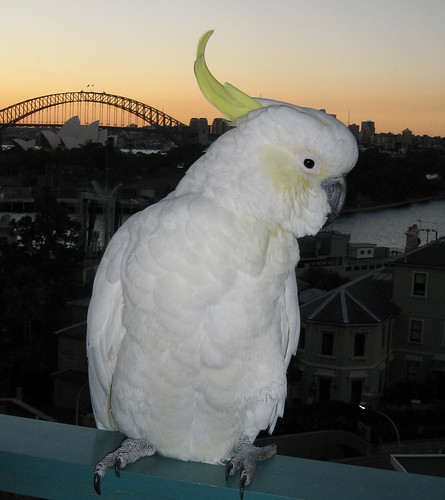
  • The wildlife! I have yet to see a kangaroo outside of a conservation park, but even the everyday wildlife is pretty impressive! The spiders are enormous (yikes) and all over the place at this time of year, but the birds more than make up for them. (Well, most of the time. No number of encounters with cool birds could make up for the morning last month when I woke up just in time to see a large, leggy black spider start crawling toward my bed across the ceiling. Great for my reflexes, not so good for my nerves.) The day I arrived, I saw what looked like a cockatoo fly past my window but thought it must be the jet lag. The next morning, I realized that, no, there actually were cockatoos flying around - lots of them. It turns out they're about as omnipresent in suburban Sydney as pigeons are in Central Park. Ibis and green parrots are pretty common too, not to mention some of the most mournful sounding ravens I've ever heard. There are also some birds with beautiful calls that I haven't been able to identify yet, but I love listening to them.
Despite being 15 to 17 hours ahead of most of my friends and family, between Skype, Facebook, Twitter, ready access to my email inbox (which I didn't have the last time I lived abroad) and the many parallels between Australian and American lifestyles, I usually don't feel all that far from home. But it wouldn't be an adventure abroad without some cultural quirks, and I enjoy taking note of them. What are some of your favorite quirks from your travels?


Wednesday, March 2, 2011

Australian Adventures: One Month In

Predictably, I petted my first one of these guys
before I'd been here a week.
Somehow, a month has gone by since I arrived in Sydney. A month ago Sunday, to be exact, since I started hearing "no worries" six times an hour and blinking in confusion at everyday expressions like "How're you going?" and "D'you want cash out?" It feels like I've been here both much longer and much less than a month. Longer because I've already done so much and I feel settled in; less because how could I possibly have been gone a whole month already?!

I didn't quite know what to expect from Australia. I'm a foreigner, but one who shares the same native language, albeit with a different national bent. I'm a student, but an international one whose studies take place at least half the time in a language native neither to this country nor to my own. And I'm a traveler, looking forward to learning the ins and outs of this country that is my temporary home. Where would I fit in, in Australia, on campus, in class, I wondered? Australia, with its laid-back sense of welcome, seems to say "fit in wherever you like, mate!"

That's one of the things I'm slowly realizing is a big part of what makes Australia so appealing: its unquestioning acceptance of whoever happens to show up. Sure, you have to certify that you're not a criminal and aren't trying to wipe out any of the native species to get through immigration but, once you're in, the welcome is universal. It isn't overpowering or over-eager, like a scene in a musical where every member of the cast is dancing with manic joy in the middle of the street; it's a casual "Hey, how're you going? Glad you could make it," that's extended to everyone from the man who's lived around the corner all his life to the tourist who arrived yesterday and is still fumbling with the currency.

Do I look relaxed yet?
Every single person I've met in the past month has emanated this casual acceptance and welcome. The cashier at the local Woolies (Woolworths, an Australian grocery store), who took in my bleary, jet-lagged confusion when she asked if I wanted cash out (that's cash back, for my fellow Americans) on my first evening here, put it together with my non-Aussie accent and welcomed me to the area with a smile. The waitress at Hobart's Retro Cafe who saw my Arizona driver's license as I pulled out my wallet, thought it was the coolest thing she'd seen all week and wanted my opinion on what Aussie English sounds like to American ears (charming, is the answer!). Not to mention the multiple bus drivers who have kindly advised me that the bus to my desired destination is the one that arrives on the opposite side of the street and haven't seemed at all put out at having stopped for a passenger who turned out not to be one.

The first country other than my own that I lived in long-term was France, for which I fell head-over-heels instantly, swept off my feet by the rich colors, textures, scents and sounds of everyday life, so different from what I grew up with in the U.S. Australia is more subtle - less intense, more easy-go-lucky and much less passionately opinionated - but no less convincing. Already, I find myself relaxing in a way I rarely did in the U.S., not just on the surface but right down to my bones. Despite the fact that classes are now in full swing, stress is becoming a distant memory. "No worries," which you can't help but hear every day in Australia, isn't just a phrase, it's a way of life, one that seeps into every pore and which, I have a feeling, may be impossible to get rid of once it's made its way into your system. Then again, why would you want to?

Wednesday, January 5, 2011

Embracing Travel Panic

Photo credit: Krysten_N, Creative Commons
I'm having one of those rare days of travel panic, when something in my brain wants to freak out and I can't quite find the right button to push to calm it down and turn off the nerves. I keep telling myself that I'm going to be in Australia for a solid two months, if not longer, before I head anywhere else, and there's no essential I could possibly forget that I can't get in Sydney, for heaven's sake, but today it just isn't working. I'm good at tamping down panic and pushing past nerves when I can't get rid of them, but they're still there and after 12 hours of feeling them bounce around in my head and my stomach, they're starting to drive me a little nuts.

Between the two browsers I use, there are 39 tabs open on my screen right now, since my usual go-to method of dealing with travel panic is to flood it out by reading up (again) on where I'm going. Five deal with travel logistics, from one on AAA's site about International Driving Permits (good news: only $15 through AAA!) to my obsessive monitoring of the price of short-hop flights between Sydney and Hobart. One is my daily check of the Aussie-USD exchange rate, which got slightly less of a wince today, since it's back down to parity after a painful jump to USD$1.02 last week. One is Amazon.com's comprehensive list of content available for the Kindle in the U.S., sorted with lowest price ($0.00) first, which I'm slowly making my way through, loading up my new Kindle before I take off (not that I can't continue to do that from anywhere in the world). Ten are blog posts that have caught my eye throughout the day that I'm slowly making my way through, and three are news sites, two of them Australian.

The other 19? Gadgets, gizmos and travel "essentials" that I'm still debating the necessity of buying before I leave for Sydney, three weeks from today. Looking at those pages makes me think about where in my luggage I would stow those things, which then leads me down into the death spiral of packing panic. How am I going to fit my life into 70 pounds, plus carry-ons? My pack needs to be totally ready to head to Tasmania less than 48 hours after I land in Australia, with any non-Tassie trip items easily accessible so I can pull them out and dump them in a drawer until I get back to Sydney. Did I order the right kind of travel laundry soap? How cold is it actually going to be during the winter? Oh yikes, I'm arriving in the middle of beach season and I'm pasty and I hate swimsuits. Okay, getting off track here...

All of this is compounded by the fact that I just spent a large chunk of my savings to pay my rent in Australia for the entire year, and that I've been chasing my tail trying to get a Capital One credit card, with its coveted no foreign transaction fees guarantee, for three weeks. The card, for which I had to send yards of paperwork proving I actually live at the address I claim to inhabit (because the postal service delivers all mail in my tiny town to the post office, not to individual residences, making my permanent mailing address a P.O. Box, which credit card companies can't accept, thank you so much, Patriot Act), was supposed to arrive yesterday, at the latest. It didn't, nor did it arrive today, which set those travel panic nerves simmering again as I spent twenty minutes on the phone with Capital One this afternoon to get that card canceled and a new one issued.

Then the service through which I made my travel arrangements emailed to tell me that I had been switched to a different flight between Melbourne and Sydney after my initial flight from Los Angeles to Melbourne. For the fifth time in the three and a half months since I bought my ticket.

Photo credit: Issac Z. Schlueter, Creative Commons
After that, I gave up. Embrace the panic, I thought. You know you'll get past it and get back to pure excitement eventually; maybe letting the panic have its way is the quickest route through it. So I did. I embraced the panic, flipping back and forth between two nearly identical external hard drives I'm considering and obsessing, for the umpty-billionth time, over packing cubes versus compression sacks and whether or not I should invest in a new daypack (because they obviously don't have those in Australia).

I was hip-deep in reviews of travel sheets (because the 500 I've read in the past two months certainly weren't enough) when I overheard my mom on the phone, outlining the first few weeks of my trip for one of her friends. As she talked about my plans to spend a week in Tasmania, then hang out in Sydney for a few days before grad school orientation and treat myself to a Michael Bublé concert the night before my 26th birthday, I looked up from my laptop. She mentioned that my housing was already taken care of through the end of the year, so I could move right into an apartment, and how nice it was that "with all of this Twittering and blogging and Facebook and everything" I was already looking forward to meeting so many of the people I've been talking to in Australia.

With that, the travel panic nerves unknotted and the vague headache that had been plaguing me all day was gone. I remembered that I'm about to go live in Australia, widely believed to be one of the coolest countries on earth, for two whole years! And that, thanks to all of you who read this blog and put up with my yammering on Twitter and Facebook, I'm actually heading there already looking forward to meeting some people who know the country and its customs a lot better than I do, who've made me feel welcome months before my feet will hit Australian soil. Suddenly my world was bright and shiny again, and I couldn't help but smile. (Of course, 20 minutes later, my mom and I were flipping back and forth between some of those same 39 web pages, figuring out what she wants to give me as an early birthday gift before I leave. But we were laughing while we did it!)

So from now on, whenever that travel panic grabs hold, I'm going to embrace it and let myself freak out over the five million unknown things I'm convinced I'm forgetting and obsess about the thirty thousand details I've already taken care of. All the while trusting that, when the time is right, some little ray of sunshine will pierce the foreboding gloom cast by my nerves and send me back to Happy Traveler Land with a smile on my face, excited for the adventures that lie ahead.

Wednesday, December 1, 2010

A Tale of Two Visas

Creative Commons, Damian613
One thing about the French: they love their bureaucracy. Cinema passes, library cards and bus passes each require a passport-sized photo to verify, each time you use them, that you are actually the individual to whom each card was issued. Opening a checking account requires documentation proving that you live at the address you claim is your residence and, if you aren't the primary occupant of record, a letter from that person is necessary, along with documentation that they are, in fact, the primary occupant of record.

When I went to the French embassy in Washington during the summer of 2005 to obtain my student visa (for which one must apply in person), I was carrying approximately a pound of paperwork. In addition to my passport - in good condition, with at least two blank pages at the back - the requested photocopies of the appropriate pages and various other forms of official identification, I also had documentation of my enrollment at GW, documentation of my acceptance into my study abroad program, documentation from my parents that they had sufficient funds ($600/month was the minimum amount, I believe) to support me for the duration of my stay in France, proof of my flight itinerary, documentation from my study abroad program that I would have a legitimate place to live during my time in France, two passport-sized photos and a credit card for the visa application fee, although I no longer remember what it was - less than $150, possibly less than $100.

I walked out ninety minutes or so later, the proud bearer of a pretty French short-stay visa that took up a full page in my passport. I was a little confused as to why I had been issued a short-stay visa, since I was going to be in the country for approximately eight months, which did not, in fact, qualify as "short," but I was confident that someone would explain it to me before it expired on October 30th.

Official logo of the French Republic,
via Wikimedia Commons
Among the handful of students in my program planning to stay in France for a full year of study, rumors circulated about what was involved in securing a titre de séjour (long-stay visa). We determined that some type of medical visit was involved, and were assured that we would receive official notification of what was required and when. Sure enough, in late October, I received a letter notifying me of a medical visit in Marseille in November. I was assured that my fears of being deported because my short-stay visa actually expired at the end of October were groundless.

I made my way to the appointed office at the appropriate time on the designated day and moved from one waiting area to the next with several of my fellow students and a lot of people who looked like they were probably trying to renew their permanent resident status. My eyes were checked, my weight noted. (I can confirm that French women really don't get fat: after two months of feeling like I was consuming more food than I'd ever eaten in my life, it turned out I'd lost ten pounds.)

I was escorted to another waiting area, then called into one of three small cubicles built into one wall of the room. A woman explained that I was to remove all clothing and any jewelry from the waist up and wait to be called again for my spine x-ray, then left me to my own devices in the cubicle. I took a deep breath and expelled it - what was becoming my standard method for dealing with situations my self-conscious American brain found dauntingly immodest - then hung my clothes on the hooks provided and stashed my jewelry in my pockets. My name was called from the side of the cubicle opposite the one I'd entered - by a man's voice. I rolled my eyes at myself, took another deep breath and let it out as I stepped into the x-ray room. The doctor, or x-ray technician, or whatever he was, was relatively young and reached out to shake my hand with a smile. I bit the tip of my tongue to keep the slightly hysterical laughter in my head at bay and managed a polite greeting. Five minutes later, I was safely back in my sweater and headed back to the bus station.

Once my x-ray had been declared to show I was healthy (I assume they were looking for evidence of tuberculosis in my lungs), I was instructed to proceed to a government office, conveniently in Aix-en-Provence this time, to secure my visa. The man at the little office window on the street took my paperwork and passport, handed the passport back half a minute later, indicated I was to sign the long-stay visa, stamped and initialed it and waved me on my way with hardly a word. Despite the fact that it was November, my new visa - another colorful full-page seal - was dated October 1st, and gave me leave to stay in France through September 30th of the following year. I breathed a sigh of relief, glad to be done with the process.

Australian Coat of Arms;
public domain, via Wikimedia Commons
Obtaining my student visa for Australia was a completely different experience.

I first tried to apply this past July, wanting to get the AUS$515 payment out of the way as quickly as possible, before my credit card got too bogged down with all the other necessities of my move. I filled out the application - online, no consulate visit necessary! - but came up with an error message when I submitted it, since I was more than four months away from my projected arrival date. Oops.

I shied away from applying in late October, when I was within four months of my departure for Australia, because the exchange rate was awful for the U.S. dollar. I finally bit the bullet on Thanksgiving - last Thursday - because the Aussie had dropped back below USD$1 and I didn't want to delay too long, in case there was a problem. I provided my background information and eCoE (electronic confirmation of enrolment), certified that I'm generally a good, law-abiding person and cringed as I hit "submit" to authorize the AUS$550 charge to my credit card (apparently the cost of a student visa increased some time between July and November).

On November 26th, the day after Thanksgiving, I woke up to an email advising me that my visa had been approved, effective immediately, and that I was welcome to stay in Australia until three months after the end of my degree program. I blinked, and read it again. That was easy. Not only am I set, visa-wise, for the duration of my Masters program, but I have permission to work as soon as my classes begin in February. I don't even have to use a page of my passport, since my visa is stored online.

In summary: French student visas are pretty and cheap compared to the Australian equivalent, but Australian student visas are a better deal all around. They're significantly more expensive but allow you to work 20 hours a week while school is in session and as many hours per week as you like during school breaks, while you can't work at all on a student visa in France; you don't have to trek to the nearest consulate, as you do for a French visa; and the first visa you get for Australia is the only one you need for the duration of your studies, while France requires some hopping around in-country, after your studies have begun, before guaranteeing you can stay. My credit card is still whimpering, but the ease of the application process for my Australian student visa and the prospect of being able to work down under are going a long way toward keeping me optimistic about the whole process.

Look out, Australia, I'll be there in two months!

Thursday, November 25, 2010

Disparate Arrivals

Creative Commons, Phillip Capper
When I arrived at Marseille-Provence Airport to begin my immersive, year-long study abroad program, I had been in airports and on planes for something like 20 hours. I was tired from a sleepless Transatlantic flight and disoriented by the heat, since it hadn't occurred to me that, yes, the Mediterranean is rather warm in early September. I was reminding myself that this was it, I was in France and I'd signed a piece of paper saying I would speak French 100% of the time while I was there. (What's the word for 'luggage carousel?' I wondered as I stared at it, waiting for my bags. What about 'luggage cart?' I don't know anything!) And I was nervously repeating the introduction I'd rehearsed in my head, for after I had (hopefully) found my host mother, whose name and address I knew, but of whom I'd never seen a photo: Bonjour, je m'appelle Jessalyn. J'ai trop de bagages, je sais, je suis désolée. Because "Hello, my name is Jessalyn. I have too much luggage, I know, I'm sorry," is obviously the standard greeting for a stranger you're going to be living with for the best part of a year.

Fortunately, my host mom, Madame C., had been given a photo and spotted me as soon as I stepped out of the baggage claim area. I saw a thinly built, middle-aged redhead jumping up and down, waving a sign with my name on it and gulped as I made my way over, launching into my introduction. Madame C.'s first reaction, after greeting me with les bises (the traditional kiss on each cheek), was to exclaim at how well I spoke. Before I could protest that no, really, I was just a passable mimic with a good ear for accents, she had moved on to exclaiming about my luggage.

After a brief misunderstanding about how long I was staying and lots of internal panicking on my part, we were in the car and on our way, with me trying desperately to keep up with the historical facts about the area and tidbits of current events Madame C. tossed out. I fully understood maybe one sentence in three, but Madame C. seemed happy to relieve me of any need to speak during the drive, and I was grateful for the chance to gather my thoughts and look around.

I had half an hour or so to myself to unpack, and then it was time to tackle dinner. Madame C.'s cheerful questions about my background flustered me, but I did my best. Telling her that my dad was an engineer was easy enough, but explaining that my mom did both health and safety and development work for a national non-profit was a bit beyond the scope of my vocabulary. I settled for a convoluted explanation that her work helped support the doctors at a medical research facility in a roundabout way, and Madame C. happily took control of the conversation again while I tried to figure out how to swallow the plateful of tomates provençales in front of me, given that cooked tomatoes were high on my Foods I Do Not Eat Because They Make Me Gag list.

I fell into bed before nine o'clock, exhausted and faintly nauseated from forcing down three whole tomatoes.

Four months later, I couldn't keep a grin from spreading over my face as I power-walked through Paris' Charles de Gaulle airport, heading from customs to the gate for the short flight to Marseille. That trip was closer to 30 hours than 20, thanks to a three-hour drive to the airport and a four-hour delay in Atlanta, but despite the exhaustion that made my arms feel like lead, saying Bonjour to the customs agent and hearing the PA system announcements in French felt like coming home.

I dashed out of the arrivals hall at Marseille-Provence just in time to catch the bus to Aix. Madame C. picked me up and we went to Sunday lunch at her daughter's house, where a spring semester American student had just arrived the day before. I recognized the dazed look on her face and the pauses in conversation as she tried to find the right words in her head. Don't worry; trust me, it gets easier, I told her as I took several tomates provençales, now one of my favorite dishes, from the platter being passed.

Arrivals in new places can be overwhelming, from struggles with the local language to disorientation from a long trip to cultural and culinary differences between you and the local people. But it's amazing, between an arrival and a departure or from one arrival to the next, how quickly a place where you thought you'd never fit in can start to feel like home.

Thursday, October 21, 2010

A Bug Called Bilingualism

By Man vyi, via Wikimedia Commons
It starts innocently enough: a desire to communicate, to be polite, that drives you to learn the basics of a language. As you spend time with the people who speak that language, it creeps a little further into your system: a longing to understand the whys and hows, the history - to know not just the words, but the nuance behind them. Then you find yourself stopping in the middle of a foreign street, uncertain of the words flowing through your own head, and it hits you: you're bilingual.

The symptoms of bilingualism manifest slowly, and often go completely unnoticed until you're living in another place, steeped in its language and the cultural patterns that come with it 24 hours a day. The progression, once you know the basics of a language and are immersed in it, goes something like this:
  1. You feel excited but overwhelmed by all of the new auditory and visual input flowing into your brain: at markets, in stores, in restaurants - anywhere you interact with locals. You make use of the basic vocabulary you've built up, occasionally stumbling or forgetting a word. You're exhausted by dinnertime every day from working so hard to keep up and communicate; you sleep a lot.
  2. Your bilingual dictionary is your new best friend. You rush to it when you get home to look up the half dozen words you really could have used on that coffee date, read the newspaper with it open on the table beside you and reach for it at random moments to look up a word you've just realized you might need. You battle occasional bouts of uncharacteristic shyness when speaking, terrified of choosing the wrong word or saying something that makes you sound ridiculous.
  3. Your speech becomes less stilted, you lose the excruciating self-consciousness that used to plague you when making casual conversation and you occasionally hear yourself using words you had no idea you knew. You cautiously expand your reading material and, though you still look up words for their precise definition, the context gives you the general idea and you rely less heavily on the dictionary. When traveling to nearby countries where you know just enough of the language to get around, you often find yourself tongue-tied, struggling to get the words of the third language past the second language that wants to be center-stage in your head and on your lips. You worry that the locals who speak the third language are going to think you're incapable of human speech.
  4. You start to make an occasional joke that the locals actually find funny for its content, not your pronunciation or word choice, and don't have trouble understanding common idioms, though the more obscure ones may still throw you off. You no longer have to concentrate so hard to catch every word that's spoken to you and it's been a while since you've had to ask someone to repeat what he said. When you talk to people at home, you pull literal translations of phrases you commonly use in the other language into your native speech patterns. This sometimes results in your friends asking why "bizarre" or "super" is suddenly your favorite word.
  5. You dream in the local language. This sometimes begins with a few sentences here and there in the dream and sometimes starts with a full-blown, detailed dream entirely in the second language. When the latter is the case, depending on how immersed in the language you've been, it may take a while for you to realize the dream wasn't in your native language. You're comfortable with the local language, and kind of smug about it.
  6. You fall into the linguistic "black hole." You're speaking normally and, all of a sudden, your mind goes completely blank and refuses to come up with the next word you want - in either language. This happens with alarming frequency for a while, making you wonder if trying to master another language has the side effect of slowly erasing your brain's capacity for rational thought and, if so, why no one told you.
  7. You're going about business as usual one day, thinking your thoughts, when you suddenly realize you don't know what language they're in. You stop in your tracks, wondering how it's possible you can't figure out what's going on inside your own head, when it hits you: who cares if there's something wrong with your brain? You're fluent in another language!
Bilingualism isn't something that goes away: variations on the later symptoms in the progression will continue to manifest throughout your life, punctuated by extreme excitement if you get to use your second language after not having had the opportunity for a while. With this comes a continuing interest in the society you lived in and a frustrated annoyance with other foreigners who discuss or write about it and "get it wrong." Occasional dreams in the language continue, sometimes seemingly out of the blue, and every now and then, when speaking your native language, all you can think of for the concept you're trying to talk about is the vocabulary for it in your second language.

Bilingualism is a bug you can live with. Some of the symptoms may be exhausting, disorienting and embarrassment inducing, but you learn to embrace them. They're merit badges - evidence that you look at the world and the life you live in it through multiple lenses, creating your own unique worldview that's informed and influenced by the cultures and the people you've spent time with and the languages that share space in your head. I'm bilingual, and I love every minute of it.

(WARNING: Contracting bilingualism may make you more susceptible to, or encourage a desire to experience, multilingualism. N.B. People whose native language is not English are often not nearly as excited by the idea of bilingualism as you think they should be, since many of them grew up with the idea that bilingualism was a necessary part of modern life, rather than an adventure to be savored. These people have also often mastered an intimidating number of languages and local dialects. It's perfectly acceptable to be in awe of them.)