Showing posts with label grad school. Show all posts

Wednesday, March 2, 2011

Australian Adventures: One Month In

Predictably, I petted my first one of these guys
before I'd been here a week.
Somehow, a month has gone by since I arrived in Sydney. A month ago Sunday, to be exact, since I started hearing "no worries" six times an hour and blinking in confusion at everyday expressions like "How're you going?" and "D'you want cash out?" It feels like I've been here both much longer and much less than a month. Longer because I've already done so much and I feel settled in; less because how could I possibly have been gone a whole month already?!

I didn't quite know what to expect from Australia. I'm a foreigner, but one who shares the same native language, albeit with a different national bent. I'm a student, but an international one whose studies take place at least half the time in a language native neither to this country nor to my own. And I'm a traveler, looking forward to learning the ins and outs of this country that is my temporary home. Where would I fit in, in Australia, on campus, in class, I wondered? Australia, with its laid-back sense of welcome, seems to say "fit in wherever you like, mate!"

That's one of the things I'm slowly realizing is a big part of what makes Australia so appealing: its unquestioning acceptance of whoever happens to show up. Sure, you have to certify that you're not a criminal and aren't trying to wipe out any of the native species to get through immigration but, once you're in, the welcome is universal. It isn't overpowering or over-eager, like a scene in a musical where every member of the cast is dancing with manic joy in the middle of the street; it's a casual "Hey, how're you going? Glad you could make it," that's extended to everyone from the man who's lived around the corner all his life to the tourist who arrived yesterday and is still fumbling with the currency.

Do I look relaxed yet?
Every single person I've met in the past month has emanated this casual acceptance and welcome. The cashier at the local Woolies (Woolworths, an Australian grocery store), who took in my bleary, jet-lagged confusion when she asked if I wanted cash out (that's cash back, for my fellow Americans) on my first evening here, put it together with my non-Aussie accent and welcomed me to the area with a smile. The waitress at Hobart's Retro Cafe who saw my Arizona driver's license as I pulled out my wallet, thought it was the coolest thing she'd seen all week and wanted my opinion on what Aussie English sounds like to American ears (charming, is the answer!). Not to mention the multiple bus drivers who have kindly advised me that the bus to my desired destination is the one that arrives on the opposite side of the street and haven't seemed at all put out at having stopped for a passenger who turned out not to be one.

The first country other than my own that I lived in long-term was France, for which I fell head-over-heels instantly, swept off my feet by the rich colors, textures, scents and sounds of everyday life, so different from what I grew up with in the U.S. Australia is more subtle - less intense, more easy-go-lucky and much less passionately opinionated - but no less convincing. Already, I find myself relaxing in a way I rarely did in the U.S., not just on the surface but right down to my bones. Despite the fact that classes are now in full swing, stress is becoming a distant memory. "No worries," which you can't help but hear every day in Australia, isn't just a phrase, it's a way of life, one that seeps into every pore and which, I have a feeling, may be impossible to get rid of once it's made its way into your system. Then again, why would you want to?

Wednesday, January 5, 2011

Embracing Travel Panic

Photo credit: Krysten_N, Creative Commons
I'm having one of those rare days of travel panic, when something in my brain wants to freak out and I can't quite find the right button to push to calm it down and turn off the nerves. I keep telling myself that I'm going to be in Australia for a solid two months, if not longer, before I head anywhere else, and there's no essential I could possibly forget that I can't get in Sydney, for heaven's sake, but today it just isn't working. I'm good at tamping down panic and pushing past nerves when I can't get rid of them, but they're still there and after 12 hours of feeling them bounce around in my head and my stomach, they're starting to drive me a little nuts.

Between the two browsers I use, there are 39 tabs open on my screen right now, since my usual go-to method of dealing with travel panic is to flood it out by reading up (again) on where I'm going. Five deal with travel logistics, from one on AAA's site about International Driving Permits (good news: only $15 through AAA!) to my obsessive monitoring of the price of short-hop flights between Sydney and Hobart. One is my daily check of the Aussie-USD exchange rate, which got slightly less of a wince today, since it's back down to parity after a painful jump to USD$1.02 last week. One is Amazon.com's comprehensive list of content available for the Kindle in the U.S., sorted with lowest price ($0.00) first, which I'm slowly making my way through, loading up my new Kindle before I take off (not that I can't continue to do that from anywhere in the world). Ten are blog posts that have caught my eye throughout the day that I'm slowly making my way through, and three are news sites, two of them Australian.

The other 19? Gadgets, gizmos and travel "essentials" that I'm still debating the necessity of buying before I leave for Sydney, three weeks from today. Looking at those pages makes me think about where in my luggage I would stow those things, which then leads me down into the death spiral of packing panic. How am I going to fit my life into 70 pounds, plus carry-ons? My pack needs to be totally ready to head to Tasmania less than 48 hours after I land in Australia, with any non-Tassie trip items easily accessible so I can pull them out and dump them in a drawer until I get back to Sydney. Did I order the right kind of travel laundry soap? How cold is it actually going to be during the winter? Oh yikes, I'm arriving in the middle of beach season and I'm pasty and I hate swimsuits. Okay, getting off track here...

All of this is compounded by the fact that I just spent a large chunk of my savings to pay my rent in Australia for the entire year, and that I've been chasing my tail trying to get a Capital One credit card, with its coveted no foreign transaction fees guarantee, for three weeks. The card, for which I had to send yards of paperwork proving I actually live at the address I claim to inhabit (because the postal service delivers all mail in my tiny town to the post office, not to individual residences, making my permanent mailing address a P.O. Box, which credit card companies can't accept, thank you so much, Patriot Act), was supposed to arrive yesterday, at the latest. It didn't, nor did it arrive today, which set those travel panic nerves simmering again as I spent twenty minutes on the phone with Capital One this afternoon to get that card canceled and a new one issued.

Then the service through which I made my travel arrangements emailed to tell me that I had been switched to a different flight between Melbourne and Sydney after my initial flight from Los Angeles to Melbourne. For the fifth time in the three and a half months since I bought my ticket.

Photo credit: Issac Z. Schlueter, Creative Commons
After that, I gave up. Embrace the panic, I thought. You know you'll get past it and get back to pure excitement eventually; maybe letting the panic have its way is the quickest route through it. So I did. I embraced the panic, flipping back and forth between two nearly identical external hard drives I'm considering and obsessing, for the umpty-billionth time, over packing cubes versus compression sacks and whether or not I should invest in a new daypack (because they obviously don't have those in Australia).

I was hip-deep in reviews of travel sheets (because the 500 I've read in the past two months certainly weren't enough) when I overheard my mom on the phone, outlining the first few weeks of my trip for one of her friends. As she talked about my plans to spend a week in Tasmania, then hang out in Sydney for a few days before grad school orientation and treat myself to a Michael Bublé concert the night before my 26th birthday, I looked up from my laptop. She mentioned that my housing was already taken care of through the end of the year, so I could move right into an apartment, and how nice it was that "with all of this Twittering and blogging and Facebook and everything" I was already looking forward to meeting so many of the people I've been talking to in Australia.

With that, the travel panic nerves unknotted and the vague headache that had been plaguing me all day was gone. I remembered that I'm about to go live in Australia, widely believed to be one of the coolest countries on earth, for two whole years! And that, thanks to all of you who read this blog and put up with my yammering on Twitter and Facebook, I'm actually heading there already looking forward to meeting some people who know the country and its customs a lot better than I do, who've made me feel welcome months before my feet will hit Australian soil. Suddenly my world was bright and shiny again, and I couldn't help but smile. (Of course, 20 minutes later, my mom and I were flipping back and forth between some of those same 39 web pages, figuring out what she wants to give me as an early birthday gift before I leave. But we were laughing while we did it!)

So from now on, whenever that travel panic grabs hold, I'm going to embrace it and let myself freak out over the five million unknown things I'm convinced I'm forgetting and obsess about the thirty thousand details I've already taken care of. All the while trusting that, when the time is right, some little ray of sunshine will pierce the foreboding gloom cast by my nerves and send me back to Happy Traveler Land with a smile on my face, excited for the adventures that lie ahead.

Tuesday, December 14, 2010

The Secret of Life

As individual as each of us is, as much as we insist on making our own way and living our own lives, we always have preconceptions of what's "normal" based on the opinions of the people around us and the status quo as we were growing up.

College graduation, May 2007.
For me, this moment felt like
a given, but that isn't the
case for everyone.
In my hometown, an affluent beach suburb that prides itself on the quality of its schools and the achievements of its students, going to college isn't a question for most people. There, a college education is perceived by most as a necessity, a stepping stone to adulthood and a life of purpose, whatever that purpose may be. I never questioned that I would go to college, and the fact that neither marriage nor children were part of my plan until, at the very least, a few years after I had finished that bachelor's degree seemed like the most normal thing in the world.

So when I was asked last week what my "secret" is for being 25, unmarried, fairly well-traveled and about to start my graduate work, my first reaction was to blink in surprise, speechless. But I don't have a secret, I thought. Isn't that pretty normal? With the possible exception of the well-traveled part for some, I don't think my situation is all that different, on the surface, from that of a lot of 25-year-olds around the world.

Then I started to put the question into context: I'm not in an urban area anymore - in fact, I'm a three-hour drive from any major city. This part of Arizona, which my parents moved to when I was a sophomore in college, is rural, much of it is far from affluent and many of the schools struggle to get a decent percentage of their students successfully through the state-mandated testing. Some of the kids who grow up here do go on to one of the state's public colleges, but for many of the people who live here, a college degree may as well be the moon. And most people are married and starting families by their early 20s. In my seven months here so far, I haven't met or heard of anyone else my age who isn't married.

The man who asked my "secret" for living my life as I have has two young daughters, whom he wants to see get their degrees and explore the world; he and his wife are planning a family vacation overseas when they're a little older. In this area, as in a lot of the U.S., making a trip like that is a big deal and I was touched by this man's concern for his daughters' future and his desire to show them that a life that is "the norm" for this area isn't their only option.

After my initial surprise at his question, I started to think about what pushed me to study and travel as much as I could. Yes, some of my motivation for getting my degree was because it was expected, but I was genuinely interested in the subjects I chose to study and I enjoyed spending time on them, years of sleep deprivation aside. Studying abroad was something I felt compelled to do, if time and money allowed, and I don't regret a moment of it, despite the fact that it made my last year of college extremely hectic. When I started my bachelor's degree, I didn't think much about grad school, but as my interests have developed, it's become clear that the path I hope to follow into the future will be more accessible with a Masters degree - and I'm lucky enough to be able to work toward that new goal while indulging my love of travel. So it seems that having a passion for something - or several things - and the drive to pursue it is my "secret."

While the ideas of normality that each of us grow up with will never entirely fade, they don't define our lives unless we let them. (And one sure way to blow any idea of "normal" out of the water is to travel and see how different life is for people around the world.) I think Caecus got it right when he said, "Each man is the architect of his own fate." I believe that, and, though the path I'm following may be influenced by other people and may change direction, I will always be the one making the decision to change course or continue straight ahead - no one else can decide my life's direction for me. What's your secret to living the life you want?

Wednesday, December 1, 2010

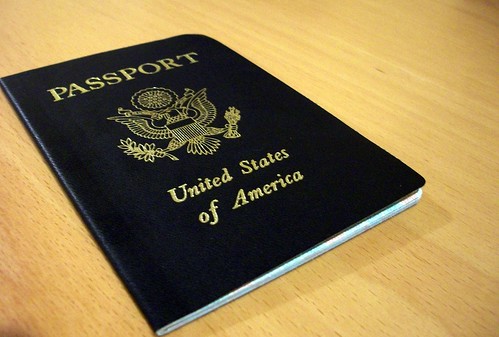
A Tale of Two Visas

Creative Commons, Damian613
One thing about the French: they love their bureaucracy. Cinema passes, library cards and bus passes each require a passport-sized photo to verify, each time you use them, that you are actually the individual to whom each card was issued. Opening a checking account requires documentation proving that you live at the address you claim is your residence and, if you aren't the primary occupant of record, a letter from that person is necessary, along with documentation that they are, in fact, the primary occupant of record.

When I went to the French embassy in Washington during the summer of 2005 to obtain my student visa (for which one must apply in person), I was carrying approximately a pound of paperwork. In addition to my passport - in good condition, with at least two blank pages at the back - the requested photocopies of the appropriate pages and various other forms of official identification, I also had documentation of my enrollment at GW, documentation of my acceptance into my study abroad program, documentation from my parents that they had sufficient funds ($600/month was the minimum amount, I believe) to support me for the duration of my stay in France, proof of my flight itinerary, documentation from my study abroad program that I would have a legitimate place to live during my time in France, two passport-sized photos and a credit card for the visa application fee, although I no longer remember what it was - less than $150, possibly less than $100.

I walked out ninety minutes or so later, the proud bearer of a pretty French short-stay visa that took up a full page in my passport. I was a little confused as to why I had been issued a short-stay visa, since I was going to be in the country for approximately eight months, which did not, in fact, qualify as "short," but I was confident that someone would explain it to me before it expired on October 30th.

Official logo of the French Republic,
via Wikimedia Commons
Among the handful of students in my program planning to stay in France for a full year of study, rumors circulated about what was involved in securing a titre de séjour (long-stay visa). We determined that some type of medical visit was involved, and were assured that we would receive official notification of what was required and when. Sure enough, in late October, I received a letter notifying me of a medical visit in Marseille in November. I was assured that my fears of being deported because my short-stay visa actually expired at the end of October were groundless.

I made my way to the appointed office at the appropriate time on the designated day and moved from one waiting area to the next with several of my fellow students and a lot of people who looked like they were probably trying to renew their permanent resident status. My eyes were checked, my weight noted. (I can confirm that French women really don't get fat: after two months of feeling like I was consuming more food than I'd ever eaten in my life, it turned out I'd lost ten pounds.)

I was escorted to another waiting area, then called into one of three small cubicles built into one wall of the room. A woman explained that I was to remove all clothing and any jewelry from the waist up and wait to be called again for my spine x-ray, then left me to my own devices in the cubicle. I took a deep breath and expelled it - what was becoming my standard method for dealing with situations my self-conscious American brain found dauntingly immodest - then hung my clothes on the hooks provided and stashed my jewelry in my pockets. My name was called from the side of the cubicle opposite the one I'd entered - by a man's voice. I rolled my eyes at myself, took another deep breath and let it out as I stepped into the x-ray room. The doctor, or x-ray technician, or whatever he was, was relatively young and reached out to shake my hand with a smile. I bit the tip of my tongue to keep the slightly hysterical laughter in my head at bay and managed a polite greeting. Five minutes later, I was safely back in my sweater and headed back to the bus station.

Once my x-ray had been declared to show I was healthy (I assume they were looking for evidence of tuberculosis in my lungs), I was instructed to proceed to a government office, conveniently in Aix-en-Provence this time, to secure my visa. The man at the little office window on the street took my paperwork and passport, handed the passport back half a minute later, indicated I was to sign the long-stay visa, stamped and initialed it and waved me on my way with hardly a word. Despite the fact that it was November, my new visa - another colorful full-page seal - was dated October 1st, and gave me leave to stay in France through September 30th of the following year. I breathed a sigh of relief, glad to be done with the process.

Australian Coat of Arms;
public domain, via Wikimedia Commons
Obtaining my student visa for Australia was a completely different experience.

I first tried to apply this past July, wanting to get the AUS$515 payment out of the way as quickly as possible, before my credit card got too bogged down with all the other necessities of my move. I filled out the application - online, no consulate visit necessary! - but came up with an error message when I submitted it, since I was more than four months away from my projected arrival date. Oops.

I shied away from applying in late October, when I was within four months of my departure for Australia, because the exchange rate was awful for the U.S. dollar. I finally bit the bullet on Thanksgiving - last Thursday - because the Aussie had dropped back below USD$1 and I didn't want to delay too long, in case there was a problem. I provided my background information and eCoE (electronic confirmation of enrolment), certified that I'm generally a good, law-abiding person and cringed as I hit "submit" to authorize the AUS$550 charge to my credit card (apparently the cost of a student visa increased some time between July and November).

On November 26th, the day after Thanksgiving, I woke up to an email advising me that my visa had been approved, effective immediately, and that I was welcome to stay in Australia until three months after the end of my degree program. I blinked, and read it again. That was easy. Not only am I set, visa-wise, for the duration of my Masters program, but I have permission to work as soon as my classes begin in February. I don't even have to use a page of my passport, since my visa is stored online.

In summary: French student visas are pretty and cheap compared to the Australian equivalent, but Australian student visas are a better deal all around. They're significantly more expensive but allow you to work 20 hours a week while school is in session and as many hours per week as you like during school breaks, while you can't work at all on a student visa in France; you don't have to trek to the nearest consulate, as you do for a French visa; and the first visa you get for Australia is the only one you need for the duration of your studies, while France requires some hopping around in-country, after your studies have begun, before guaranteeing you can stay. My credit card is still whimpering, but the ease of the application process for my Australian student visa and the prospect of being able to work down under are going a long way toward keeping me optimistic about the whole process.

Look out, Australia, I'll be there in two months!

Thursday, November 11, 2010

How did I get here?

What lies ahead?

Tracing back the paths you've taken (or onto which life has shoved you) to see how, exactly, you've arrived at your current destination can be an interesting and eye-opening process. What might have happened if you hadn't taken that job? Where might you be now if your parents hadn't moved when you were a kid?

Sitting on the floor in the middle of my bedroom, with guidebooks, the travel stories of others, maps and lists spread out around me, it's interesting to think about how I wound up here, planning for a two-year graduate program in Australia and all the travel I can fit in during study breaks.

It was reading Srini Rao's post on The Skool of Life yesterday, "How I ended up with The Greatest Job In the World," that got me thinking about all of this. Here I am, in my sixth month of living with my parents, more than five years after accepting that I'd never live under their roof again. And I'm enjoying it! I like living in a house again, rather than an apartment, I like being able to look outside and see trees and birds, rather than city streets, and I love being able to spend so much time with my parents before I head off to the other side of the world. And, thanks to the internet and the ability to tele-commute, I'm still at the same full-time job I've had for the past three years, so I don't feel like I'm taking advantage of my parents' generosity.

But it was an entirely random amalgam of discussions, decisions and dissension that brought me here, and I so easily could have missed the chance for this adventure. Here are just a handful of the twists and turns that have brought me to this point:
  • My parents moved from Florida, where I was born, to Southern California when I was still a baby. If I hadn't grown up in SoCal and decided that I wanted to experience something beyond the beach bubble, I might never have become interested in international issues and I might have headed to California, instead of away, for college.
  • My sophomore year of high school, I was torn between two summer programs, one at Northwestern and one at Georgetown. It was while at Georgetown that I stumbled (literally) onto GW's campus, which led to its becoming my alma mater. If I'd picked the Northwestern program, I might never have applied to GW and I'd probably have majored in psychology at Bucknell. (Which might have meant not studying abroad, and never discovering my passion for translation.)
  • It wasn't until I got into a relationship with a guy considering law school that I started thinking seriously about going to grad school just a few years after college. And the fact that he was considering Stanford and called northern California home made me quick to put the translation and interpretation (T & I) program in Monterey on my list. When we broke up, the program was still at the top of my list, but being in California suddenly wasn't quite so important anymore.
  • One evening in 2007, I uncharacteristically went to the awful, rundown gym in the first building I lived in after college and had a conversation with a woman who'd run her first marathon the year before. Eight months later, I was training for my first marathon and now, more than three years after that conversation and having completed six marathons of my own, I'm much more in tune with my own strength - physical and emotional - and am more willing than ever before to embrace my sense of adventure.
  • I applied for a Fulbright scholarship - and didn't get it. If I had, grad school would have been pushed back and, since the scholarship I applied for would have taken me to France, might have ended up being in Europe.
  • I did a random search for graduate T & I programs and came across one in Australia. Mostly joking, I sent the link to a friend. He was the one who found the dual Masters program I'm starting in February (T & I, plus international relations) by digging a little deeper on the school's site, and kept after me to apply until I gave in, did the math and figured out that it would actually be less expensive - and infinitely more fun - than the program I was planning to attend in Monterey.
There are countless things we do - every year, every month, every day - that influence, on some level, the places we end up in the future and the courses our lives take. I know there are other directions my life could have gone that would have made me happy. But right now? I'm thrilled that this path is the one my life has taken. And I can't wait to see where it leads me next.

Friday, October 8, 2010

A Wandering Student Tackles Packing, Part I

Confession: I'm a pack rat. I've gotten infinitely better about it in the past five years or so, but there was a time not so long ago when I wouldn't let my mom get rid of any of my old stuffed animals, even the ones I completely ignored as a kid. I'm much more practical than I used to be, but I'm still wildly sentimental and afraid of throwing out anything that might possibly be useful somewhere down the road.

My luggage for my first experience studying outside the U.S. was a picture-perfect example of how not to pack that still makes me cringe. For my first semester, I essentially threw every piece of clothing there was a remote possibility I might wear into the large duffel bag, large suitcase and carry-on suitcase I took with me, until I ran out of room. I came to my senses a little bit before winter break and brought half a suitcase of clothes it had become clear I was not going to wear back home with me, but the books, notebooks and souvenirs I accumulated by the end of the year more than made up the difference.

I've since learned how to pack for most travel situations with only carry-on luggage (although being a runner who hates to go more than a day or two without a run sometimes makes that difficult on longer trips), and that empty space in a suitcase won't kill me but is, in fact, a good thing.

Packing for two years in Australia, however, is going to be a challenge.

My first step toward making the process a smooth, efficient one was to buy a backpack, which will be a good way to get things to Australia that will easily convert to being a good way to travel during school breaks. I went to REI while I was in Southern California this past weekend, since I live nowhere near any outdoor stores and the REI a friend of mine works at was right around the corner from my hotel.

I've never bought a pack before, so I did my research before even thinking about actually buying one. I got measured and semi-fitted for a few I was considering months ago, then did some more research. I went into REI thinking I knew which pack I wanted (a women's Osprey Aura 65), but it didn't feel all that great once it was weighted. An incredibly helpful employee named Nelson (hooray for friends of friends!) who is much more knowledgeable about backpacks and how they should fit than I am loaded up four separate packs for me, tweaked the fit and told me what looked good and what didn't to his experienced eye. The Aura seemed to carry the weight too high, I loved the fit of the hip belt in the Gregory I tried on but the shoulder straps felt like they were grinding bone, the REI-brand pack was okay but nothing spectacular and I wasn't thrilled with the idea of a top-loading pack with just one pocket.

Please forgive my terrible photography
skills when it comes to large inanimate
objects that aren't scenery.
 The women's Deuter ACT Lite 60 + 10 SL surprised me. Since there's only one size that you adjust with a series of "rungs" built into the back, I expected it to fit poorly and be too big for my short torso. But once Nelson had adjusted it for my height and we had all of the straps dialed in, it felt great. Twenty pounds isn't a lot of weight, but it was enough to make me seriously uncomfortable with the packs that didn't fit properly; with the Deuter on, I felt like I could walk around all day. I wandered around the store for a while (looking ridiculous since I was wearing a sundress and sandals with no support at all thanks to having been at the local fair all day) and finally decided this was it. The yellow flower that comes with each of these packs is a fun bonus, but it'll be coming off before I head down under. It's pretty, cheerful and I love the color and the little bit of flair it adds, but it screams "I'm a woman - rob me!" just a little too much for comfort. (But good job, Deuter marketing department!) Maybe I'll toss it in to wear in my hair now and then.

Charming, but probably not a good idea for
actual backpacking.
Since I'm going to be living in Australia for two years and will have a semi-permanent base at school, my new pack isn't all I'll take, in the interest of not having to do laundry twice a week and being able to settle in a bit. I'm still debating whether a 60-liter pack qualifies as a carry-on. Largely empty and cinched down this weekend, it fit in the overhead bin just fine and the Southwest employee I asked about it said it was an acceptable carry-on size, but I'm not sure that will be the case when it's full (any opinions on or experiences with this, please let me know!). If I do end up carrying on my pack, I'll check a rolling duffel - maybe two - and carry on a shoulder bag to go under my seat. If not, I'll check my pack and a rolling duffel, and probably carry on a rollerbag and a daypack.

With three-and-a-half months to go before I leave, I'm still feeling pretty ahead of the game (except that now I want to take my pack everywhere with me so I get used to it - and because it's pretty). Next up on the packing checklist: figuring out what's going in the luggage!

Saturday, September 25, 2010

Counting down to Oz

Courtesy of Navin75, Creative Commons
So, why Diary of a Wandering Student and why now? The short answer is that I'll be heading to Australia's Macquarie University for grad school in a few months and I want to establish a space to record my adventures and hear about yours before I head Down Under and am too caught up in exploring a new region of the world to think about creating a blog to talk about my experience there.

I've been counting down to my February 2011 orientation for almost a year already, since I received my official acceptance into Macquarie's Masters of Translating and Interpreting with a Masters of International Relations program in December 2009, but my impending departure is starting to seem more real lately. Exponentially more real this week, since - drumroll, please - I bought my ticket to Sydney on Monday!

I'll leave on January 25th and arrive midday on January 27th (when that whole losing-a-day thing, which makes sense in theory, will likely throw me off for a while in practice), two weeks before orientation begins and I become a full-time student again. Since I'll be arriving from cold, snowy winter in the Arizona mountains in the middle of Sydney's summer, the current plan is to head south to cooler Tasmania for a few days, maybe a week, and explore some of the national parks that make up about 40% of the island state. I'll spend the rest of my pre-orientation time exploring North Ryde, Sydney and environs, hopefully finding local gems (the best local markets, tea shops, parks, beaches, cafés, etc.) - and learning how to order coffee, Aussie-style (long, short, black, flat, white...I know the terminology, but haven't quite made sense of how it relates to how Americans order coffee)!

One thing that's stood out as I've been asking around about Oz and researching the dos, don'ts and history of the Lucky Country is that no one I've talked to - not even one person - who's visited Australia has a single negative thing to say about their time there. Usually when you ask around about a country, some people will tell you they loved it, some will have had a mediocre experience and at least one or two will have been seriously annoyed by some aspect of the local culture. When you ask around about Australia, people tell you how lucky you are to be going and that you'll love it. Then they ask how long you'll be staying and if they might come visit.

Needless to say, I can't wait to go. I hope you'll join me in my wanderings, both before I leave and after I land in Oz.

Sunday, September 19, 2010

Found in Translation

An earlier version of this post was initially posted on my personal blog, There Is No Spoon, in July. It explains my decision to study international relations, translation and interpretation (which ended up also being a decision to go to grad school in Australia!) and my love of language, so I'm reposting an edited version here, since these decisions were crucial to my continuing journey as a wandering student.

I'm four months out, give or take a week or two, from my departure for Australia, and anticipation is building by the day. I've finally bought and broken in hiking boots, found a new rolling duffel after bidding a fond farewell to the most beat-up of the two that saw me through four years of college and nearly three years of post-grad life and - after considerable research - have chosen a pack in which to lug more of my stuff to the other side of the world and been fitted for the right size. I filled out my housing application this summer and am nervously toying with ideas for scholarship essays. I've loosely planned out my course schedule for the two years of my Masters program. I'm so excited, both to travel in a new part of the world and to study subjects I love, that some days I feel like I'm going to burst.

One thing I realized I haven't done, however, is explain my choice in courses of study. My choice of school was one thing, but I haven't touched much at all on why I want a Masters of Translating and Interpreting with a Masters of International Relations in the first place. (On a side note: every time I babble out that mouthful to someone who asks what I'm going to be studying, there's a moment of stunned silence while they try to digest what I've just said. It makes me feel a little ridiculous.) So, here goes...

My one required course my second semester abroad in college was English to French Translation. Translation was a scary word. And, actually, it sounded kind of boring. Why would I want to take someone else's words and plug them into another language when I could write my own, in either language? I dreaded that class throughout first semester, when two of my friends were taking it, despite their protestations that they liked it. About halfway through my first translation, an excerpt from David Sedaris' Holidays on Ice, a light blinked on in my head. This is translation? This is fun! What was I worried about?

Translation became one of my two favorite classes that semester, not least because of my professor, a professional translator in her own right, and one who understands that languages can - and should be - fun. What I learned from her, and through the practice of translating several pages of varying material each week, was that translation is a far cry from something as simple as transposing a word from one language into the matching word in another.

Like people, language has baggage. Words have a history that's tied to the places they come from, the places they're used and the evolving cultures of the people who use them. And finding the right way to communicate not just the meaning of the word itself but all the nuance of its baggage requires an understanding of cultures on both sides of the translation. (Of course, this doesn't apply quite as often or to the same degree when you're talking about translating instructions for assembling a piece of furniture; we've all laughed at the stilted language in manuals for things manufactured in another country.)

Part of the translator's or interpreter's job, especially when it comes to literary translation (which is feared by translators far and wide as the black hole of the industry, in which you lose yourself and never make any money - so, naturally, it's my favorite type of translation) and diplomatic interpreting, is having a firm grasp of the historical and cultural baggage of both the language he or she is translating from, and the language she's translating into. That knowledge, and the ability to translate nuance and background without interrupting the flow of the text - or the speaker's rhythm, in interpretation - is the mark of a good translator. Which means, when you're dealing with a good one, you won't even be aware that they're there (or hardly, in the case of an interpreter), and you'll be able to read or listen to the thoughts of someone from thousands of miles away, with a background that may be radically different from yours, as though they lived in the house down the street.

And that - that bridging of physical, cultural and linguistic space - is why I want to be a translator and an interpreter. I tend to view the world in terms of relationships, between people, between words, between cultures. What's the same? What's different? How does what's different relate to what I know and understand? Usually, what's different has some point of reference to what I know, that makes what might at first seem alien at least something I can grasp, if not fully comprehend. And it's those points of reference, those connections between languages, that let us bridge the gap between cultures and appreciate the lives and thoughts of men and women to whom we may never have given a passing thought, but whose lives - and livelihoods - are inextricably linked to our own.

Our world is getting smaller, and the need to communicate more effectively, more thoroughly and more often with others is growing. Much of the world is in crisis, whether humanitarian, environmental or economic, and that isn't a reality that's going to change anytime soon, especially if we don't talk to one another across the political and linguistic boundaries in which we've barricaded ourselves. There are great ideas out there, in every corner of the world, and translating them, language by country by continent, can only help our collective future.

I dream about a world where every idea - an environmental solution, a discovery in astronomy, a humanitarian cry for help, a literary daydream - races from person to person around the globe within moments of its inception, sparking interest, aid and inspiration. Largely thanks to the internet and affordable international travel, we're closer to that dream than we were thirty years ago, but we still have a long way to go. In becoming a translator and an interpreter, I hope to bring us just a little closer to making that dream a reality.