Showing posts with label language. Show all posts

Thursday, November 25, 2010

Disparate Arrivals

Creative Commons, Phillip Capper
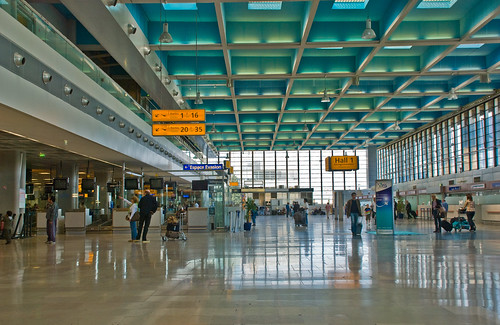
When I arrived at Marseille-Provence Airport to begin my immersive, year-long study abroad program, I had been in airports and on planes for something like 20 hours. I was tired from a sleepless Transatlantic flight and disoriented by the heat, since it hadn't occurred to me that, yes, the Mediterranean is rather warm in early September. I was reminding myself that this was it, I was in France and I'd signed a piece of paper saying I would speak French 100% of the time while I was there. (What's the word for 'luggage carousel?' I wondered as I stared at it, waiting for my bags. What about 'luggage cart?' I don't know anything!) And I was nervously repeating the introduction I'd rehearsed in my head, for after I had (hopefully) found my host mother, whose name and address I knew, but of whom I'd never seen a photo: Bonjour, je m'appelle Jessalyn. J'ai trop de bagages, je sais, je suis désolée. Because "Hello, my name is Jessalyn. I have too much luggage, I know, I'm sorry," is obviously the standard greeting for a stranger you're going to be living with for the best part of a year.

Fortunately, my host mom, Madame C., had been given a photo and spotted me as soon as I stepped out of the baggage claim area. I saw a thinly built, middle-aged redhead jumping up and down, waving a sign with my name on it and gulped as I made my way over, launching into my introduction. Madame C.'s first reaction, after greeting me with les bises (the traditional kiss on each cheek), was to exclaim at how well I spoke. Before I could protest that no, really, I was just a passable mimic with a good ear for accents, she had moved on to exclaiming about my luggage.

After a brief misunderstanding about how long I was staying and lots of internal panicking on my part, we were in the car and on our way, with me trying desperately to keep up with the historical facts about the area and tidbits of current events Madame C. tossed out. I fully understood maybe one sentence in three, but Madame C. seemed happy to relieve me of any need to speak during the drive, and I was grateful for the chance to gather my thoughts and look around.

I had half an hour or so to myself to unpack, and then it was time to tackle dinner. Madame C.'s cheerful questions about my background flustered me, but I did my best. Telling her that my dad was an engineer was easy enough, but explaining that my mom did both health and safety and development work for a national non-profit was a bit beyond the scope of my vocabulary. I settled for a convoluted explanation that her work helped support the doctors at a medical research facility in a roundabout way, and Madame C. happily took control of the conversation again while I tried to figure out how to swallow the plateful of tomates provençales in front of me, given that cooked tomatoes were high on my Foods I Do Not Eat Because They Make Me Gag list.

I fell into bed before nine o'clock, exhausted and faintly nauseated from forcing down three whole tomatoes.

Four months later, I couldn't keep a grin from spreading over my face as I power-walked through Paris' Charles de Gaulle airport, heading from customs to the gate for the short flight to Marseille. That trip was closer to 30 hours than 20, thanks to a three-hour drive to the airport and a four-hour delay in Atlanta, but despite the exhaustion that made my arms feel like lead, saying Bonjour to the customs agent and hearing the PA system announcements in French felt like coming home.

I dashed out of the arrivals hall at Marseille-Provence just in time to catch the bus to Aix. Madame C. picked me up and we went to Sunday lunch at her daughter's house, where a spring semester American student had just arrived the day before. I recognized the dazed look on her face and the pauses in conversation as she tried to find the right words in her head. Don't worry; trust me, it gets easier, I told her as I took several tomates provençales, now one of my favorite dishes, from the platter being passed.

Arrivals in new places can be overwhelming, from struggles with the local language to disorientation from a long trip to cultural and culinary differences between you and the local people. But it's amazing, between an arrival and a departure or from one arrival to the next, how quickly a place where you thought you'd never fit in can start to feel like home.

Sunday, November 7, 2010

Saturday Snapshot: Wandering Waterways


I've always had a thing about water. Whether it stems from the soothing sound, having grown up by the ocean or maybe being born on the cusp between Aquarius and Pisces, I have no idea, but it's a good bet that, if there's a body of water around, I'm near it (or in it, depending on the season).

One of my favorite ways to find my bearings in a new city or collect my thoughts in a familiar one is to wander through it on foot, usually by the river - the fact that large cities are usually settled on or near one has become one of my favorite things about them. The Seine is an integral part of the path I always walk through Paris shortly after I arrive; when I needed to get off campus in college, I walked along the Potomac; my favorite running trail in DC after college paralleled that same river; I got lost multiple times in Prague, but as soon as I found the Vltava I knew where I was; I can't get enough of the Embarcadero in San Francisco. The list goes on, much the same for nearly every city I've been to.

Today's photo was taken in London at about this time of year in 2005, when a friend and I decided to take the Chunnel up from France during our fall break. I had expected that, after speaking nothing but French for two months, speaking English would be a relief. Instead, I found myself confused by the unfamiliar accents and struggling to figure out a lexicon that wasn't quite the same as the one I was used to. I felt sluggish and stupid every time I had to ask someone to repeat himself, which was often. After buying tickets for a museum or ordering food in a restaurant, switching back to French to speak with my friend was a relief.

Linguistic difficulties aside, I felt comfortable in London the moment I set foot in it (as long as I wasn't required to speak, at any rate). Something in the air, something about the pace of life there, reminded me so much of Washington that it was impossible not to feel at home. And the moment I set eyes on the Thames, London went from being a nice, mostly comfortable place to be to a city I loved. I took a ridiculous number of photos looking over the Thames, of bridges crossing the Thames, of double-decker buses on bridges crossing the Thames...fully half of my pictures of London, like this one, involve the river.

I spent hours on the catwalks of Tower Bridge, watching the river and the city speeding past on its banks. I spent an afternoon walking along the banks of the Thames, watching buskers and tourists alike. One of the first places I took my parents when we all went to London several months later was across the Wibbly-Wobbly Bridge (the Millenium Bridge, if we're being precise), to look at the river. Despite the fact that I was across a continent and an ocean from the place I considered home, I looked at the Thames and thought that - at that moment - there was nowhere I'd rather be.

So if we ever happen to be traveling together and I wander off, listen for the sound of waves crashing, water lapping or a river running, then follow it, and you'll almost certainly find me.

Wednesday, November 3, 2010

Profiles in Transit: Antonio

Creative Commons, guillenperez
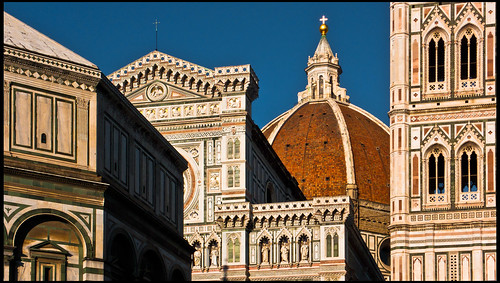
The walls of the buildings around the piazza diffused the afternoon sunlight so that it flowed over the cobblestones, gilding them with that spectrum of light that is so uniquely Tuscan. The sun's rays spilled over my skirt, drawing me into the picture-perfect Florentine afternoon as though I belonged there.

I smiled to myself as I wrote my postcards, pausing often to look around the piazza and bask in the October sunshine, happy just to sit and enjoy the afternoon while my friends explored a museum I hadn't had energy left to gear myself up for after spending hours at the Cattedrale di Santa Maria del Fiore and the Galleria dell'Accademia.

An elderly gentleman walked into the square and took the seat adjacent to mine on the circular bench where I was writing. After several moments, he spoke and, since I was the only one around, I looked up and said "Scusa?" He repeated himself, gesturing toward me, then tapping his left arm. I caught the word sinistra and assumed he was commenting on the fact that I was left-handed, so I nodded. My limited Italian didn't offer any clues about his next statement, so I shook my head and said, "Non parlo italiano, signore, scusami." He grimaced, nodded and went back to watching the few people wandering through the piazza. Two or three minutes later, I saw the man turn back toward me out of the corner of my eye and heard, "Parlez-vous français, mademoiselle ?" I turned toward him, grinning, and said, "Oui !"

We spoke about trips he'd taken to France, how I was enjoying my second visit to Florence and how much I had loved San Gimignano on a trip a few years before. When I mentioned that I was actually American, not French, he told me he thought it was wonderful that I was taking advantage of my youth by traveling. It's impossible not to learn something new about life when we travel, he told me, and learning about life is how we come to know ourselves and the people around us. As he got up to leave, he took my hand in a warm, strong grasp that reminded me of my grandfather's and asked my name. "Enchanté, Jessalyn," he said, "Je m'appelle Antonio."

I spoke with Antonio for no more than ten minutes on that afternoon in Florence, and our paths haven't crossed since. I don't know what made him think to ask if I spoke French - if he saw the postcard to my French host mother, or if it was just a hunch. But the truth of what he said has stayed with me and, whenever I think of Florence, the first thing that comes to mind is a man named Antonio and the advice he gave me on a sunny October afternoon.

Thursday, October 21, 2010

A Bug Called Bilingualism

By Man vyi, via Wikimedia Commons
It starts innocently enough: a desire to communicate, to be polite, that drives you to learn the basics of a language. As you spend time with the people who speak that language, it creeps a little further into your system: a longing to understand the whys and hows, the history - to know not just the words, but the nuance behind them. Then you find yourself stopping in the middle of a foreign street, uncertain of the words flowing through your own head, and it hits you: you're bilingual.

The symptoms of bilingualism manifest slowly, and often go completely unnoticed until you're living in another place, steeped in its language and the cultural patterns that come with it 24 hours a day. The progression, once you know the basics of a language and are immersed in it, goes something like this:
  1. You feel excited but overwhelmed by all of the new auditory and visual input flowing into your brain: at markets, in stores, in restaurants - anywhere you interact with locals. You make use of the basic vocabulary you've built up, occasionally stumbling or forgetting a word. You're exhausted by dinnertime every day from working so hard to keep up and communicate; you sleep a lot.
  2. Your bilingual dictionary is your new best friend. You rush to it when you get home to look up the half dozen words you really could have used on that coffee date, read the newspaper with it open on the table beside you and reach for it at random moments to look up a word you've just realized you might need. You battle occasional bouts of uncharacteristic shyness when speaking, terrified of choosing the wrong word or saying something that makes you sound ridiculous.
  3. Your speech becomes less stilted, you lose the excruciating self-consciousness that used to plague you when making casual conversation and you occasionally hear yourself using words you had no idea you knew. You cautiously expand your reading material and, though you still look up words for their precise definition, the context gives you the general idea and you rely less heavily on the dictionary. When traveling to nearby countries where you know just enough of the language to get around, you often find yourself tongue-tied, struggling to get the words of the third language past the second language that wants to be center-stage in your head and on your lips. You worry that the locals who speak the third language are going to think you're incapable of human speech.
  4. You start to make an occasional joke that the locals actually find funny for its content, not your pronunciation or word choice, and don't have trouble understanding common idioms, though the more obscure ones may still throw you off. You no longer have to concentrate so hard to catch every word that's spoken to you and it's been a while since you've had to ask someone to repeat what he said. When you talk to people at home, you pull literal translations of phrases you commonly use in the other language into your native speech patterns. This sometimes results in your friends asking why "bizarre" or "super" is suddenly your favorite word.
  5. You dream in the local language. This sometimes begins with a few sentences here and there in the dream and sometimes starts with a full-blown, detailed dream entirely in the second language. When the latter is the case, depending on how immersed in the language you've been, it may take a while for you to realize the dream wasn't in your native language. You're comfortable with the local language, and kind of smug about it.
  6. You fall into the linguistic "black hole." You're speaking normally and, all of a sudden, your mind goes completely blank and refuses to come up with the next word you want - in either language. This happens with alarming frequency for a while, making you wonder if trying to master another language has the side effect of slowly erasing your brain's capacity for rational thought and, if so, why no one told you.
  7. You're going about business as usual one day, thinking your thoughts, when you suddenly realize you don't know what language they're in. You stop in your tracks, wondering how it's possible you can't figure out what's going on inside your own head, when it hits you: who cares if there's something wrong with your brain? You're fluent in another language!
Bilingualism isn't something that goes away: variations on the later symptoms in the progression will continue to manifest throughout your life, punctuated by extreme excitement if you get to use your second language after not having had the opportunity for a while. With this comes a continuing interest in the society you lived in and a frustrated annoyance with other foreigners who discuss or write about it and "get it wrong." Occasional dreams in the language continue, sometimes seemingly out of the blue, and every now and then, when speaking your native language, all you can think of for the concept you're trying to talk about is the vocabulary for it in your second language.

Bilingualism is a bug you can live with. Some of the symptoms may be exhausting, disorienting and embarrassment inducing, but you learn to embrace them. They're merit badges - evidence that you look at the world and the life you live in it through multiple lenses, creating your own unique worldview that's informed and influenced by the cultures and the people you've spent time with and the languages that share space in your head. I'm bilingual, and I love every minute of it.

(WARNING: Contracting bilingualism may make you more susceptible to, or encourage a desire to experience, multilingualism. N.B. People whose native language is not English are often not nearly as excited by the idea of bilingualism as you think they should be, since many of them grew up with the idea that bilingualism was a necessary part of modern life, rather than an adventure to be savored. These people have also often mastered an intimidating number of languages and local dialects. It's perfectly acceptable to be in awe of them.)

Tuesday, October 12, 2010

Profiles in Transit: Teaching Italian by Impatience

Courtesy of McLoy2008, Creative Commons
Italy, the second stop my parents and I made during my first trip out of North America at 15, was my first experience spending time in a country where my only knowledge of the language was whatever I could find in the phrasebook. I refuse to ever start a conversation by addressing someone in a language other than their own, no matter how pathetically, so I had learned the basics: Buon giorno ("Hello"), Parla inglese o francese, per favore? ("Do you speak English or French?"), Vorrei... ("I'd like..." - when in Italy, being able to order the amazing food is critical.) and some other basics, like counting to ten, please, thank you and the omnipresent scusi, for getting through crowds at least semi-politely (which, I realize, is completely un-Italian).

Throughout Florence and San Gimignano, my limited Italian worked beautifully. Someone always knew enough English or French to talk to me after I gave them my standard greeting, and my food vocabulary increased by leaps and bounds, supplemented with great words like cinghiale - wild boar. Fun to say, although my dad enjoyed the actual eating of it much more than I did.

On the train to Sorrento by way of Naples, however, I hit a linguistic wall in the form of a Trenitalia employee. I had wandered into the dining car in search of some water and approached the bored-looking woman behind the counter with a smile.

"Buon giorno!"
She nodded in return.
"Parla inglese, per favore?"
She gave a brief shake of her head and half arched a brow at me, as if to say "Why would I? And now what are you going to do, ragazza?"
"Parla francese...?"
Another head shake. Hm. Well, I'd seen enough ads for bottled water, maybe I could do this.
"Vorrei...una...um...una bottiglia di acqua? Per favore? Naturale, per favore? ("Can I have a...um...a bottle of water? Please? Still, please?")

The woman gave me a look that said, "If it didn't take so much effort, I would roll my eyes at you. Why did you ask me to speak two other languages?" and rang up the water before muttering the total at me. I paid, said "Grazie!" and sped back to my seat to tell my parents I'd spoken a whole non-pasta-related sentence in Italian.

That Trenitalia employee, sullen though she may have been, taught me a lesson that's come in handy many times over the years: it's when under pressure to communicate that you realize the full extent of what you know. That's the premise of language education by immersion: you subconsciously absorb the language you see and hear and, when given no option but to use that language to communicate, your subconscious shoves it into your conscious mind. Terrifying as it can be, it works. Even on Italian trains.

Wednesday, September 22, 2010

Profiles in Transit: Patience at la Tour Eiffel

The people who sit in the information booth at the Eiffel Tower must have one of the most exhausting jobs on the planet. People storm the booth in droves, asking questions in broken French and a myriad of languages from around the world, the answers to most of which they could find by simply reading the signs posted around the plaza at the base of the monument. Or by turning to the right page in one of their six dozen guidebooks.

The Eiffel Tower was one of my first stops in Paris on my first trip there with my parents. I was 15, and had recently finished third-year French as a freshman in high school, so my mom sent me to ask her question. I formulated it carefully in my head as I walked toward the information booth, and was encouraged when the man in the booth smiled at me as I stepped up to the window. "Bonjour," I said, pleased when his smile widened a bit and he responded in kind.

I don't remember what the question was, but I asked it and he answered - slowly, but without being too obvious that he was taking extra care with his enunciation. I said "Merci!" and sauntered back to my parents with the answer, proud of myself for understanding it. My mom remembered another question she wanted to ask and sent me back...then remembered a third question when I came back with the answer to that one. I was embarrassed to be back at the information booth's window again so quickly, but since the man inside was still smiling when I arrived for the third time, I fumbled my way through the last question - the trickiest, making use of some of the complex grammar I had just learned - and the man patiently waited for me to finish, then repeated his answer twice when I wasn't certain I understood after the first time. I thanked him again and joined my parents to make the climb to the top.

I never got the name of the man who was working in the information booth that day, and I have only a vague memory of his face - maybe early 30s, on the pale side, brown hair and a medium build - but, 10 years later, I still think of him often. Whenever someone complains about how rude Parisians are, how they never let you finish a sentence in French without interrupting to tell you to continue in English, how they're insufferable when it comes to helping English speakers, I remember this man. At one of the most popular attractions in Paris, he was patient enough to let me stumble through my limited French not once, but three times. As busy as he was on a tourist-filled June morning, he was careful to speak slowly enough for me to understand every word. His kindness, his patience and his smile are what I've come to expect when traveling through France, and I have yet to meet with anything less. And when I see struggling tourists in a city where I feel at home, I try to offer them assistance with the same attitude that man showed me: patience, and a smile.

Sunday, September 19, 2010

Found in Translation

An earlier version of this post was initially posted on my personal blog, There Is No Spoon, in July. It explains my decision to study international relations, translation and interpretation (which ended up also being a decision to go to grad school in Australia!) and my love of language, so I'm reposting an edited version here, since these decisions were crucial to my continuing journey as a wandering student.

I'm four months out, give or take a week or two, from my departure for Australia, and anticipation is building by the day. I've finally bought and broken in hiking boots, found a new rolling duffel after bidding a fond farewell to the most beat-up of the two that saw me through four years of college and nearly three years of post-grad life and - after considerable research - have chosen a pack in which to lug more of my stuff to the other side of the world and been fitted for the right size. I filled out my housing application this summer and am nervously toying with ideas for scholarship essays. I've loosely planned out my course schedule for the two years of my Masters program. I'm so excited, both to travel in a new part of the world and to study subjects I love, that some days I feel like I'm going to burst.

One thing I realized I haven't done, however, is explain my choice in courses of study. My choice of school was one thing, but I haven't touched much at all on why I want a Masters of Translating and Interpreting with a Masters of International Relations in the first place. (On a side note: every time I babble out that mouthful to someone who asks what I'm going to be studying, there's a moment of stunned silence while they try to digest what I've just said. It makes me feel a little ridiculous.) So, here goes...

My one required course my second semester abroad in college was English to French Translation. Translation was a scary word. And, actually, it sounded kind of boring. Why would I want to take someone else's words and plug them into another language when I could write my own, in either language? I dreaded that class throughout first semester, when two of my friends were taking it, despite their protestations that they liked it. About halfway through my first translation, an excerpt from David Sedaris' Holidays on Ice, a light blinked on in my head. This is translation? This is fun! What was I worried about?

Translation became one of my two favorite classes that semester, not least because of my professor, a professional translator in her own right, and one who understands that languages can - and should be - fun. What I learned from her, and through the practice of translating several pages of varying material each week, was that translation is a far cry from something as simple as transposing a word from one language into the matching word in another.

Like people, language has baggage. Words have a history that's tied to the places they come from, the places they're used and the evolving cultures of the people who use them. And finding the right way to communicate not just the meaning of the word itself but all the nuance of its baggage requires an understanding of cultures on both sides of the translation. (Of course, this doesn't apply quite as often or to the same degree when you're talking about translating instructions for assembling a piece of furniture; we've all laughed at the stilted language in manuals for things manufactured in another country.)

Part of the translator's or interpreter's job, especially when it comes to literary translation (which is feared by translators far and wide as the black hole of the industry, in which you lose yourself and never make any money - so, naturally, it's my favorite type of translation) and diplomatic interpreting, is having a firm grasp of the historical and cultural baggage of both the language he or she is translating from, and the language she's translating into. That knowledge, and the ability to translate nuance and background without interrupting the flow of the text - or the speaker's rhythm, in interpretation - is the mark of a good translator. Which means, when you're dealing with a good one, you won't even be aware that they're there (or hardly, in the case of an interpreter), and you'll be able to read or listen to the thoughts of someone from thousands of miles away, with a background that may be radically different from yours, as though they lived in the house down the street.

And that - that bridging of physical, cultural and linguistic space - is why I want to be a translator and an interpreter. I tend to view the world in terms of relationships, between people, between words, between cultures. What's the same? What's different? How does what's different relate to what I know and understand? Usually, what's different has some point of reference to what I know, that makes what might at first seem alien at least something I can grasp, if not fully comprehend. And it's those points of reference, those connections between languages, that let us bridge the gap between cultures and appreciate the lives and thoughts of men and women to whom we may never have given a passing thought, but whose lives - and livelihoods - are inextricably linked to our own.

Our world is getting smaller, and the need to communicate more effectively, more thoroughly and more often with others is growing. Much of the world is in crisis, whether humanitarian, environmental or economic, and that isn't a reality that's going to change anytime soon, especially if we don't talk to one another across the political and linguistic boundaries in which we've barricaded ourselves. There are great ideas out there, in every corner of the world, and translating them, language by country by continent, can only help our collective future.

I dream about a world where every idea - an environmental solution, a discovery in astronomy, a humanitarian cry for help, a literary daydream - races from person to person around the globe within moments of its inception, sparking interest, aid and inspiration. Largely thanks to the internet and affordable international travel, we're closer to that dream than we were thirty years ago, but we still have a long way to go. In becoming a translator and an interpreter, I hope to bring us just a little closer to making that dream a reality.