Monday, August 8, 2011

How Southeast Asia Broke My Internal Thermostat

It didn't actually rain the afternoon this was taken, so I'm
assuming that's mostly smog in the sky behind Wat Phra Kaew's
impressive ornamentation, not clouds - either way, it did a great job
of keeping Bangkok predictably hot and sticky.
I am not a hot weather person. Growing up in the temperate climate of Southern California, I was spoiled by summers that maxed out at about 27ºC and winters where temperatures of less than 10ºC were shocking. After an uncomfortable season or two on the U.S.' East Coast in college, I adapted to winters involving below-freezing temperatures without much trouble. I even, to some degree, learned to enjoy the cold that made spring seem all the sweeter once it finally arrived. Extreme heat, however, I stayed as far away from as possible. If I had a choice between bundling into a coat and baking in a tank top, I'd almost always choose the former - or the latter with a heavy dose of air-conditioning.

So while planning my April jaunt to Southeast Asia earlier this year, I expected to be pretty darn uncomfortable throughout the majority of my trip. April is the region's hottest month, meaning there are few places where the high is likely to be below 30ºC (or, really, more like 33°) and nighttime lows don't bring much relief.

On the evening of my arrival, I stepped out of Bangkok's Suvarnabhumi Airport shortly after 11pm and, rather than the cool ocean breeze I'd left behind in Sydney, felt the sticky Thai heat creep under my skin. After spending five summers in swampy Washington, DC, I'm no stranger to the unpleasant combination of intense heat and sky-high humidity, but there's a pervasiveness to the Thai atmosphere that's unlike anything I'd experienced before: the air has weight, substance and pushes back against your every movement. Slow down, it says, you're not going anywhere in a hurry, so just relax and go with the flow. Mai pen rai - no worries! (The only thing in the entire country that seems to be immune to this is Bangkok traffic.)

By the time I got into the taxi that would take me to my hostel near Siam Square, every inch of my skin was coated with a fine sheen of sweat that felt like it had been there since the day I was born. I walked into my hostel room and whimpered when I saw the request not to set the thermostat any lower than 23ºC - as hot as I was, 20º sounded like it might, possibly, after several hours, be cool enough. But I'd come to Southeast Asia wanting to experience it as it is (as much as possible for a blonde-haired, blue-eyed farang), so I set the thermostat for the prescribed 23º and eventually cooled off enough to fall asleep.

In sticky Bangkok, it's the little things - like
a 20-baht fan and a cold Diet Coke - that keep
you comfortable.
I split the next day between the overwhelming sprawl of Chatuchak Weekend Market and Wat Phra Kaew, home of the Emerald Buddha, and realized a couple of hours in that, oddly enough, the heat wasn't that bad. It was still sweltering and the lack of a breeze made it more so, but at some point it had stopped bothering me. Maybe it was that I'd slowed my pace to a leisurely stroll or that I'd purchased a hand-held fan from a vendor at Chatuchak for 20 baht (quite possibly the best roughly 65 cents I've ever spent) that helped stir the air around my face. Whatever it was, by the end of the day I was pleased to conclude that, while 36°C with 95% humidity would never make my list of favorite weather conditions, neither was it going to bother me too much for the next two weeks. (In the interest of full disclosure: I still spent the day covered in sweat and gulping copious amounts of water, but I wasn't unhappy about it. Although knowing I had an air-conditioned hostel to go back to at the end of the day might have helped with that.)

It wasn't yet 8am, but the heat was enough to
have already drained half my battery. (At least,
I assume it was the heat and not the repeated
attempts at getting a photo with both me and
Angkor Wat in it...)
Several days later I had crossed the border into Cambodia, where the intensity of the sun made Bangkok look like a nice, shady park in comparison. To me, Siem Reap didn't feel as sticky as Bangkok had, but it was several degrees hotter and lacked Bangkok's thick smog to cut the beating of the sun's rays. The clearest indication of the difference came during my one and only day at Angkor Wat. Throughout my time in Thailand, as long as I charged my camera battery each night, I didn't have a problem; in Cambodia, the heat was so intense that my battery started sputtering three hours after I arrived at Angkor and died less than an hour after that. (Angkor Wat tip: Take extra camera batteries!) I spent the little time I had in Siem Reap sweaty and flushed, but - just like in Bangkok - didn't really care.

After Siem Reap, I headed back into Thailand, this time North to Chiang Mai, where the first day of Songkran was winding down as I arrived. For those of you who are unfamiliar with your Theravada Buddhist holidays, Songkran is the Thai festival that celebrates the Lunar New Year in mid-April. The rituals surrounding the New Year have to do with the bathing of living spaces, Buddha images and monks and making merit or paying tribute to elders...but for all intents and purposes, what it's really become is a nation-wide water fight lasting from one to three days (or more!), depending on where you are. And, as most of the travel blogosphere will tell you, Chiang Mai is the place to be for Songkran.

Songkran-enforced cool. I think I've left
water parks drier than this. (If you're not
seeing any wet spots, it's because there
aren't any dry ones!)
What does all of this Songkran business have to do with the heat, you ask? Well, when I say water fight, I mean an all-out assault with water guns, hoses, buckets and bowls, being sprayed, thrown at or dumped on you by everyone on the street, from children barely big enough to walk to their grandparents. Let's just say that, whatever the weather, it's not hard to stay cool during Songkran, especially if you happen to be in Chiang Mai. (It's also a ridiculous amount of fun, but that's for another post.)

One thing I did notice about my reaction to the heat while I was in Chiang Mai was that I was no longer wishing I could set the air-conditioning down to 20°, as I had that first night in Bangkok. In fact, I often found myself setting it at 25°, or even shutting it off altogether. The same was true when I reached Koh Lanta, one of the Southern islands on the Andaman Sea side. The humidity there was especially brutal, so I kept the air-conditioning on at night to cut through it and set the fan on low to keep the air moving around the bed and blow the few mosquitoes that found their way into my bungalow away, but I found myself setting the thermostat to 25° or higher and still needing to bundle into my sweater to sleep. What was happening to me?!

Back in Sydney, I arrived toward the end of April to find that it had been raining for a week and would continue for most of the next. It wasn't particularly cold, but I was freezing. I wore layers of sweats and two pairs of socks. I huddled in bed at night, shivering until I warmed up enough to fall asleep. I drank copious amounts of tea and coffee, clutching at the mug until every remnant of warmth had faded. When the temperature dropped to 15° at night - a temperature I had greeted with a sigh of relief in Tasmania when my visit coincided with Sydney's 40°+ February heat wave - I whimpered and briefly considered adding a third pair of socks. After a month of this, I decided it was official: Thailand and Cambodia had smashed my internal thermostat to pieces. In two weeks of steamy weather, Southeast Asia had not only overridden my lifelong aversion to temperatures above 24° degrees, it had me longing for them.

While I've gotten a bit better in the three months since my return (read: I don't start staring wistfully at the heater until it drops to 22°, rather than 25°), I still find myself craving heat at temperatures I used to think were ideal and sighing in relief when I step into the bright Sydney sun, rather than looking for a patch of shade. I imagine that I'll continue to shift back toward "normal" until I'm once again grumbling at 30° temperatures, but it may be a while. Or maybe I should just head back to Thailand or Siem Reap...at this point, I'm getting kind of sick of wearing two pairs of socks.

Thursday, July 21, 2011

My 7 Links

Thanks to Marsha's kind nomination on Single Occupancy Blog, Diary of a Wandering Student is back in action after a much-too-long hiatus (due to a combination of end-of-semester insanity and extreme post-finals laziness) with my post for Tripbase.com's My 7 Links Project. The project asks nominated bloggers to take a look back at old posts and highlight seven in various categories.

I was expecting this to be difficult since, with a blog less than a year old, I thought I wouldn't have much to choose from for some of the categories, but it turned out that choosing between some of my favorite posts that I'd forgotten about was harder! At any rate, here goes...

My most beautiful post | Profiles in Transit: Antonio

I was torn between three posts in this category, the other two because they feature what I consider to be some of my best photography, but my heart was wrapped up in this post long before I wrote it and I'm proud of how I was able to capture the beauty of a few moments with a stranger in words, not images. This is one post I was completely satisfied with when I re-read it after posting, which was a relief, since I was incredibly nervous about finding the right words to express a beautiful experience.

My most popular post | A Bug Called Bilingualism

In terms of actual hits, my post about Antonio is my most popular, since it was re-tweeted by Lonely Planet (that was a great feeling!), among others, but this one was a big success for a three-weeks-live blog and got me really excited about how many people out there are as interested as I am in the crazy experience that is immersing yourself in a foreign language and the culture that goes with it.


I haven't written any posts that have turned out to be what I'd call controversial - not surprising, since I'm a pretty can't-we-all-get-along type - but I was worried that this one might be. I was concerned that some might read it as bashing my fellow Americans travelers, when it was intended instead to highlight how radically different travelers from the same country can be and how it can impact their experiences abroad. Fortunately, no one I heard from took it the wrong way and the general opinion seemed to be that we all have compatriots who fit certain unflattering travel stereotypes that make us cringe.

My most helpful post | A Table for One?

Apparently I need to write more posts aimed at being helpful, because this was a tough one to figure out! I hope my post about my first solo travel experience encouraged a few people to take the leap and give solo travel a try, or at least start thinking about it, because the fact that not having any friends or relatives who want to take a particular trip with me doesn't mean I can't travel has been one of the best discoveries of my life.

A post whose success surprised me | Getting Hustled in NYC

This post was intended to highlight an (I'd like to think) rare moment of out-of-town stupidity and the importance of paying attention to your instincts, but the comments really took off and I was pleasantly surprised by how many new faces chimed in supportively. It just goes to show that unpleasant people like the hustler featured in the post are the exception and kind, friendly ones are the norm!

A post I feel didn't get the attention it deserved | Why travel?

This post had a higher than usual ratio of comments to page hits, but I felt like it never really got the exposure it should have, maybe because it was posted shortly before Christmas and New Year's. It's a post I love, because I feel like I was really able to capture what travel means to me: the okay-this-is-a-little-scary moments, the thrill of stepping into the unknown and, above all else, the sheer joy of exploring somewhere new.

The post I'm most proud of | A Whirlwind Romance in Cambodia

This isn't my best-written post, my funniest, my most touching or my most popular, but it is one that I'm very proud of. Why? Because, if I'd visited Cambodia even just five years ago, I would never have written it. Five years ago, I was barely beginning to scratch the surface of solo travel and, while I might have taken a solo trip to Southeast Asia if the opportunity had presented itself, I would have been much too busy worrying about everything that could go wrong to let myself see or fully appreciate the beauty the region has to offer. Before I left in April, I knew I would be comfortable traveling through Thailand and Cambodia by myself, but I didn't expect to view my time in Cambodia as much more than an interesting learning experience. The fact that I've become comfortable enough as a traveler, solo or not, to relax and let myself fall in love with a country so radically different from my own is something that makes me incredibly happy. Which is why the fact that I was able to write this post makes me proud.

Sharing the My 7 Links love. Wow, travel blog community, you've been busy. My 7 Links has spread like wildfire around the blogosphere! Only two bloggers I know haven't been nominated yet, so their links - a wonderful soon-to-be-expat blog by my friend Alyssa and a mouth-watering foodie blog by my friend Leran - are below, so take a look! If you haven't yet been nominated and want to be, shoot me a tweet - I have three nominations left!


Tuesday, May 31, 2011

Profiles in Transit: Pau Thom

Siem Reap, Cambodia
"Hey lady, where you from?" echoed off the buildings on either side of the narrow alleyway as I turned down it and two boys no more than ten years old fell into step with me. Used to the rhythm of this exchange after two days in Siem Reap, I said "The U.S. - California" and kept walking, knowing they'd keep pace.

Sure enough, the boy who'd greeted me rattled off President Obama's name, the U.S. and California capital cities, (former) Governor Schwarzeneggar's name and even a couple of quotes from the Terminator movies. I laughed and kept walking.

"Hey lady, I remember you, I talked to you yesterday!" the boy said, unexpectedly. I stopped and looked at him, then smiled. "You're right, I remember you too!"

"So today you buy my postcards, eh? Yesterday no, but today yes?" I looked at the cards but realized I had bought the same set the day before outside Angkor Wat's Ta Prohm, from a girl no more than five years old who broke my heart when she said she hoped I would buy her postcards because she wanted to go to school.

"I'm sorry, I already have these ones," I said, feeling regretful and wondering if I should buy a second set - I genuinely liked this kid.

After a brief pause, he said, "I'm still hungry today, maybe you could buy me some food instead?" My heart cracked again and, after my own brief pause to consider the idea, I said, "Sure, what do you want to eat?"

"This way, I'll show you," he said, leading me down another alley and making me momentarily consider the potential folly of following a stranger - even a friendly, juvenile one - through the streets of a Southeast Asian city I didn't know particularly well.

"My name is Pau Thom," he said, practically skipping as his friend and I walked alongside, "what's yours?"

"Jessalyn," I answered, pronouncing it slowly.

The Siem Reap alleyway Pau led me down
(which, consequently, I'd taken a photo of an
hour earlier) in search of his favorite chicken amok.
"Jessalyn," he repeated (more accurately than most Americans, to be honest) "Okay, now I remember your name and we can play! I remember you when you go back to California."

I laughed and restrained the urge to rumple his hair as I would have done to my niece. "And I'll remember you whenever I think about Siem Reap."

We grinned at each other as we crossed a street and approached a small restaurant with tarps pieced together serving as a roof and a plastic-coated menu sitting on a rickety pedestal outside. Pau flipped through it, then pointed to a chicken amok dish. "That's what I want to eat."

"Okay," I said and asked the waitress to bring him an order of the dish, along with a Coke when he said that was what he wanted to drink. Pau's friend slipped away before I could ask what he wanted, but Pau got settled at a table and I paid the waitress for his meal (which cost all of $3.00, U.S.). He looked small and more than a little lost at the four-person table by himself, completely out of his element - happy about it in some ways, since he was clearly hungry, but not quite sure what to do with himself while he waited for his meal. I wanted to sit and keep him company but was already past the time I should have been heading back to my guesthouse to finish packing and head to the airport, so instead I told him I had to leave. He gave me his crooked, sunny smile and waved, "Bye, Jessalyn-California!"

I smiled and waved back, murmuring "Bye Pau," knowing I was leaving a little piece of my heart behind as I walked away, but glad to carry the memory of that crooked smile and sunny disposition with me as I moved on.

There are hundreds of children in the same position as Pau on the streets of Siem Reap and Angkor Wat, not to mention thousands throughout the rest of Cambodia. Some of them are bitter after years of watching foreigners come and go who are never hungry and don't lack for anything; most of them are resigned; and some of them, like Pau, are cheerful despite the hardships they face and, whether they know it or not, bring smiles to the faces of the people they interact with every day. Some people may question my decision to buy Pau a meal and that's fine - for me, it was a way to help that didn't involve simply handing over money (which, once I'd declined to buy his postcards, he didn't ask for anyway), since that's something I try not to do. Pau made my day significantly brighter and I hope that I was able to do the same for him in some measure.

My one regret is that I didn't get a picture of that cheerful, charmingly crooked smile of his. I'm still painfully shy when it comes to asking people I meet while traveling if I can take their picture and, while it doesn't affect my memories, it does have an impact on the degree to which I can share those memories with you. Hopefully by the next time I meet someone like Pau, I'll have overcome my shyness enough to ask if I can take a quick snapshot to remember them by.

Tuesday, May 10, 2011

A Whirlwind Romance in Cambodia

I didn't expect to fall in love during my not quite three days in Cambodia. I planned to see what I could of Angkor Wat in such a short time, browse some local markets and head on to Chiang Mai with no regrets. But then my flight from Bangkok started its descent, I caught my first glimpse of the Cambodian countryside and my grasp on my no-nonsense, let's-see-the-sights-and-move-on mentality slipped. Why didn't anyone tell me Cambodia's beautiful? I wondered. Variations on that same thought played through my mind on repeat every moment I was there and long after my feet had left Cambodian soil.

My first glimpses of Siem Reap were full of
dust and intense heat from the back of a
tuk-tuk - and were absolutely enchanting.
The tuk-tuk ride from Siem Reap International Airport to my guesthouse was windy, dusty and brutally hot - and I loved every moment of it. I couldn't stop the smile that kept stealing over my face as I looked around, watching the motorbikes that zipped past, the farmers working in fields and rice paddies near the road and the multi-colored houses and shops that lined the streets. Most of the big hotels looked ridiculously out of place - I've never been more pleased that my budget doesn't run to luxury accommodation.

Mr. Thorn, my tuk-tuk driver, pulled up in front of a pretty, peach-colored building and I walked into the charm of Hotel 89's lobby.

After arranging for my visit to Angkor Wat the next day with the front desk, then making myself at home in a room that was comfortable and welcoming (and air-conditioned!) at only USD $15 per night, I wandered toward Pub Street and the center of Siem Reap.

The quality of light in Cambodia is unlike anything I've seen
anywhere else in the world, and it adds to the lush beauty of
the countryside in a way that's completely captivating.
With every step, I was more enchanted. I'd never before been in a place where all of the action on the street seemed to take place so completely at the same level. Sure, I was (sometimes) on a sidewalk, but motorbike drivers grinned at me as they went flying past my elbow, local occupants of tuk-tuks looked at me with curiosity and the cars quickly made it clear that the idea of pedestrian right-of-way definitely does not exist in Siem Reap and that if I wanted to cross, I had better saunter partway (and not at an intersection - who uses those?), wait in the middle of the street for them to drive past and then continue on my way, like everyone else.

After a souvenir stop at fair trade merchant Rajana and a dinner of delicious tofu amok and Angkor Beer at Pub Street's Le Tigre du Papier, I wound my way back through town, sharing a stricken look and then a laugh with a moto driver who happened to speed past just as I was catching my balance after tripping over a crack in the sidewalk.

Angkor is a vast subject unto itself (and will have its own post somewhere down the road!), but I can tell you that I loved it and that it only deepened my appreciation for the region and the Cambodian people.

Life in Cambodia may not be easy, but it's
as vibrant as its street traffic.
I don't want to give the impression that Siem Reap is all rainbows and butterflies - it's very far from it. Landmine victims hobble down the street on what's left of their legs, begging for money or food; children who should be in school fall into step with you, asking where you're from and repeating a litany of facts they've had drilled into them about your country or state, trying to convince you to buy a set of postcards; both poor standards of living and abject poverty are evident everywhere you look.

But the strength of spirit of the Cambodian people is equally evident. They may have nothing more to offer than a smile and a joke, but they're unfailingly generous with those. Their sunny cheer, as they call out "Hey lay-dee, need a tuk-tuk?" from across the street or offer directions when you're looking particularly lost, is incomparable and blends with their country's mesmerizing quality of light and colorful culture to form a national charm that's impossible to hold out against.

I flew into Cambodia expecting a couple days' worth of history lessons. I flew out with an entirely unanticipated love of the country and deep respect for its people that will keep me ready to jump at any chance to go back.

Sunday, April 10, 2011

A Whirlwind Tour: Ready, Set, Go!

I arrived at Bangkok's Suvarnabhumi International Airport
last night.
Photo Credit: JoeDuck, Creative Commons
Oh boy. Oh boy, oh boy, oh boy, oh boy, oh boy. Ridiculous, but as of noon yesterday, this was what had been going through my head pretty much non-stop for the previous 48 hours, since my last class before April break (fall break, down here in Australia) ended on Thursday afternoon. I felt like a little kid on Christmas Eve, or on the day before a trip to Disneyland: I couldn't think about anything else and felt like I was revving in neutral, burning off excited energy by bouncing around in my seat. Why all the hyperactivity?

I landed in Thailand last night.

Just typing that sentence sets off another round of internal squeals of excitement. We have a little more than two weeks off, which I'll be spending in Bangkok, Chiang Mai and Koh Lanta, with a couple of days across the Cambodian border in Siem Reap and at Angkor Wat. It's going to be a bit of a whirlwind, especially at first, since I'll be going somewhere new about every two days, but I didn't want to regret not fitting in the trip to Angkor. I'll have a little longer in Chiang Mai and nearly a week in Koh Lanta, where - if the weather cooperates - I'm hoping to get my dive certification.

When I was growing up, I was so enamoured of France and then of Europe in general that I had very little interest in Asia. Not to mention, as a young teenager the idea of going somewhere that seemed so utterly foreign was more terrifying than exciting. But, on a whim my sophomore year of college, I picked up a compilation of travelers' stories about Thailand and my interest began to grow. By the time I returned to the States from my year in France, Southeast Asia was firmly on my travel wishlist - for some time in the hazy future.

Choosing an Australian postgraduate program turned my world upside in more ways than one. Oceania and Asia, which had been filed under "someday" in my travel plans, jumped to the top of the list overnight and I discovered an enthusiasm and anticipation for Southeast Asia in particular that were far stronger than I had realized.

With a larger-than-usual tax return due to having paid most of the costs of my first year of grad school in early 2010 and a two-week break scheduled for April, visions of Thai street food and markets began to dance in my head and I started to look at fares from Sydney to Bangkok. When I started to plan out possible itineraries, I surprised myself again when I realized that I already knew exactly what I wanted this first trip to Asia to include: Bangkok, Chiang Mai, dive certification at one of the southern beaches and a jaunt into Cambodia to visit Angkor Wat - if I could work out the timing to fit it all in.

After some agonizing about whether to include Angkor and destination-hop every few days for the first part of my trip or to leave it out and spend more time exploring Chiang Mai and southern Thailand, I decided to include a few days in Cambodia. I know myself well enough to be sure that coming so close to such a major site without going to see it would drive me crazy.

I arrived in Bangkok late last night and, after a few hours' sleep, am ready to dive in. First up: Chatuchak Weekend Market, followed by some temple time.

So it's Bangkok, Siem Reap, Chiang Mai, Koh Lanta and me for the next two weeks: ready, set...go!

Tuesday, April 5, 2011

Upside Down and 17 Hours Ahead

Three of Sydney's cultural icons in one shot!
Photo credit: S Baker, Creative Commons
I wasn't sure what to expect in terms of culture shock in Australia. I didn't expect it to be particularly shocking, both because Australia is a developed, English-speaking country, like the U.S., and because for me it's generally reverse culture shock that really trips me up. So, while I didn't expect moving to Australia to throw me too much off my stride, I was curious to see just what differences would stand out.

After two months, I'm feeling pretty at home in Sydney (despite my dad's ongoing assertions that I'm upside down - thanks, Dad), but there's a random assortment of little things that are just different enough to remind me that I'm on the other side of the world. Here are some of the highlights:

  • Everything is on the left. Having spent a few days in London, I wasn't a total stranger to the idea of cars with right-side drive and traffic on the left-hand side of the road but somehow the fact that the same rule might apply to things like sidewalks completely escaped me. After screeching to a halt at the foot of an escalator in Melbourne's Tullamarine Airport and blearily wondering why the right-hand escalator was the down escalator from the floor above, common sense pierced the veil of jet lag and I figured it out. It took a few days in Tasmania to really get walking on the left into my head, but I eventually got it. (It's not as noticeable in Sydney, where the number of residents and tourists from other countries sometimes makes it a walk-where-there's-space free-for-all.) For the past couple of weeks, I've started to look to the right first when crossing the street, rather than looking left and quickly whipping my head right, sincerely hoping I'm not about to get flattened by an oncoming car. (This is one habit I expect to have issues with back in the States!)
  • The local lingo isn't that far from American English, but it's enough to throw me completely off sometimes if I'm not paying close attention. Things like "Any cash out?" (instead of "cash back"), "ta" for "thanks" (although that's another one that doesn't seem as common in international Sydney) and "How're you going?" ("How am I what...? Ohh...I'm doing well, how are you?") are just different enough from what we say in the U.S. to occasionally give me pause. (Then there's Australian vs. American terminology and spelling when it comes to writing papers, but that's another story.)
  • Australia is expensive. Crazy expensive. $2.80 per banana expensive (granted, they're not always quite that bad). I ignored the first couple of high grocery bills, figuring it was just the necessity of stocking up on basic household goods like laundry soap and pantry staples that was making them so high, but as I've gotten more used to seeing prices in kilos, grams and liters I've realized that, no, it's just really expensive. My grocery bills are about double (if not closer to triple, depending on what I buy in the way of produce) what they were in Washington, DC. And it isn't just food that's expensive - books are the first place I noticed the price difference, and it was a huge shock. A popular new release can easily cost $50, with more "normal" paperback prices ranging from $20-$25. I asked for a Kindle for Christmas to help keep books from eating up most of my luggage allowance but once I arrived, I was even happier to have one!
  • One of my ongoing fascinations with Australia is its outlook on energy usage. It was in the high 80s and very humid when I arrived and I groaned when I walked into my apartment and realized there was no air-conditioning. From what I've seen, it's par for the course here and even larger buildings have coolings systems that are regulated much differently from the U.S. Rather than have the air-conditioning running at all times throughout an entire academic building, as we do in the States, each classroom has its own controls, the most common of which involve turning the a/c system on and having it automatically shut off after three hours. Hallways, as far as I've seen, are never air-conditioned. There were only a few days in February that were really uncomfortable and I've gotten used to making the most of cross-breezes and fans, rather than relying on central air. Considering that Sydney is just about as hot and humid as Washington, DC (although it does usually cool off more at night), where a lack of air-conditioning is viewed as an unacceptable, completely unlivable state of affairs, it's an interesting contrast.
Not the prettiest picture, but still pretty cool:
since that little switch to the left of the outlet
isn't turned on, no power is being used, despite
the number of things plugged in.
  • Then there are Australia's electrical outlets. (I know, this technically belongs under the last bullet point, but they're just so cool that they deserve their own.) I was baffled by the switches on the outlet plate covers when I first arrived, but ignored them. After plugging in a fan and wanting to cry when it wouldn't turn on and get the air moving in my room, I flicked the switch next to the outlet just to see what happened and - ta-da! - the fan started whirring. You can shut off power to every single electrical outlet in Australia when it's not in use. How cool is that?! Not only does it help keep the electricity bill down, but it stops the slow leak of electricity through appliances that aren't in use, without the hassle of unplugging them. Green and practical!
  • The Australian government is serious about cracking down on skin cancer. Unfortunately, given its location and climate, it's probably not surprising that Australia has the highest incidence of skin cancer of any country in the world. (I can't sit in the sun for more than about twenty minutes without sunscreen on without risking a burn - so I'm going through a lot of sunscreen!) The government is tackling the problem by inundating the media with PSAs and publicity campaigns, promoting slogans like "Slip, Slop, Slap" (slip on a shirt, slop on some sunscreen, slap on a hat) and "There's nothing cool about a tan." This actually reminds me a lot of the anti-smoking campaign the California government launched when I was a kid that was, over time, pretty amazingly effective. Fingers crossed the same will be true in Australia.
This Tasmanian kangaroo's favorite thing about Australia?
Tourists who feed him (her?)!
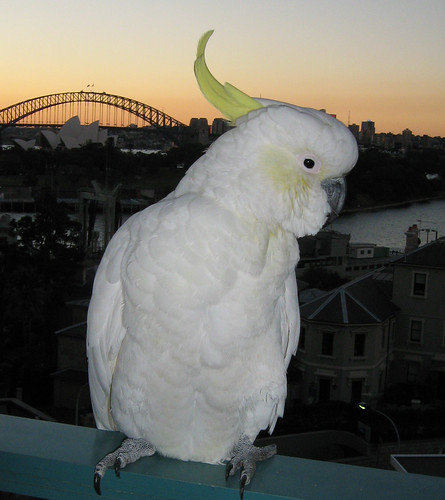
  • The wildlife! I have yet to see a kangaroo outside of a conservation park, but even the everyday wildlife is pretty impressive! The spiders are enormous (yikes) and all over the place at this time of year, but the birds more than make up for them. (Well, most of the time. No number of encounters with cool birds could make up for the morning last month when I woke up just in time to see a large, leggy black spider start crawling toward my bed across the ceiling. Great for my reflexes, not so good for my nerves.) The day I arrived, I saw what looked like a cockatoo fly past my window but thought it must be the jet lag. The next morning, I realized that, no, there actually were cockatoos flying around - lots of them. It turns out they're about as omnipresent in suburban Sydney as pigeons are in Central Park. Ibis and green parrots are pretty common too, not to mention some of the most mournful sounding ravens I've ever heard. There are also some birds with beautiful calls that I haven't been able to identify yet, but I love listening to them.
Despite being 15 to 17 hours ahead of most of my friends and family, between Skype, Facebook, Twitter, ready access to my email inbox (which I didn't have the last time I lived abroad) and the many parallels between Australian and American lifestyles, I usually don't feel all that far from home. But it wouldn't be an adventure abroad without some cultural quirks, and I enjoy taking note of them. What are some of your favorite quirks from your travels?


Wednesday, March 2, 2011

Australian Adventures: One Month In

Predictably, I petted my first one of these guys
before I'd been here a week.
Somehow, a month has gone by since I arrived in Sydney. A month ago Sunday, to be exact, since I started hearing "no worries" six times an hour and blinking in confusion at everyday expressions like "How're you going?" and "D'you want cash out?" It feels like I've been here both much longer and much less than a month. Longer because I've already done so much and I feel settled in; less because how could I possibly have been gone a whole month already?!

I didn't quite know what to expect from Australia. I'm a foreigner, but one who shares the same native language, albeit with a different national bent. I'm a student, but an international one whose studies take place at least half the time in a language native neither to this country nor to my own. And I'm a traveler, looking forward to learning the ins and outs of this country that is my temporary home. Where would I fit in, in Australia, on campus, in class, I wondered? Australia, with its laid-back sense of welcome, seems to say "fit in wherever you like, mate!"

That's one of the things I'm slowly realizing is a big part of what makes Australia so appealing: its unquestioning acceptance of whoever happens to show up. Sure, you have to certify that you're not a criminal and aren't trying to wipe out any of the native species to get through immigration but, once you're in, the welcome is universal. It isn't overpowering or over-eager, like a scene in a musical where every member of the cast is dancing with manic joy in the middle of the street; it's a casual "Hey, how're you going? Glad you could make it," that's extended to everyone from the man who's lived around the corner all his life to the tourist who arrived yesterday and is still fumbling with the currency.

Do I look relaxed yet?
Every single person I've met in the past month has emanated this casual acceptance and welcome. The cashier at the local Woolies (Woolworths, an Australian grocery store), who took in my bleary, jet-lagged confusion when she asked if I wanted cash out (that's cash back, for my fellow Americans) on my first evening here, put it together with my non-Aussie accent and welcomed me to the area with a smile. The waitress at Hobart's Retro Cafe who saw my Arizona driver's license as I pulled out my wallet, thought it was the coolest thing she'd seen all week and wanted my opinion on what Aussie English sounds like to American ears (charming, is the answer!). Not to mention the multiple bus drivers who have kindly advised me that the bus to my desired destination is the one that arrives on the opposite side of the street and haven't seemed at all put out at having stopped for a passenger who turned out not to be one.

The first country other than my own that I lived in long-term was France, for which I fell head-over-heels instantly, swept off my feet by the rich colors, textures, scents and sounds of everyday life, so different from what I grew up with in the U.S. Australia is more subtle - less intense, more easy-go-lucky and much less passionately opinionated - but no less convincing. Already, I find myself relaxing in a way I rarely did in the U.S., not just on the surface but right down to my bones. Despite the fact that classes are now in full swing, stress is becoming a distant memory. "No worries," which you can't help but hear every day in Australia, isn't just a phrase, it's a way of life, one that seeps into every pore and which, I have a feeling, may be impossible to get rid of once it's made its way into your system. Then again, why would you want to?